
From Firefighting to Growth System: How Small Teams Create More Leverage
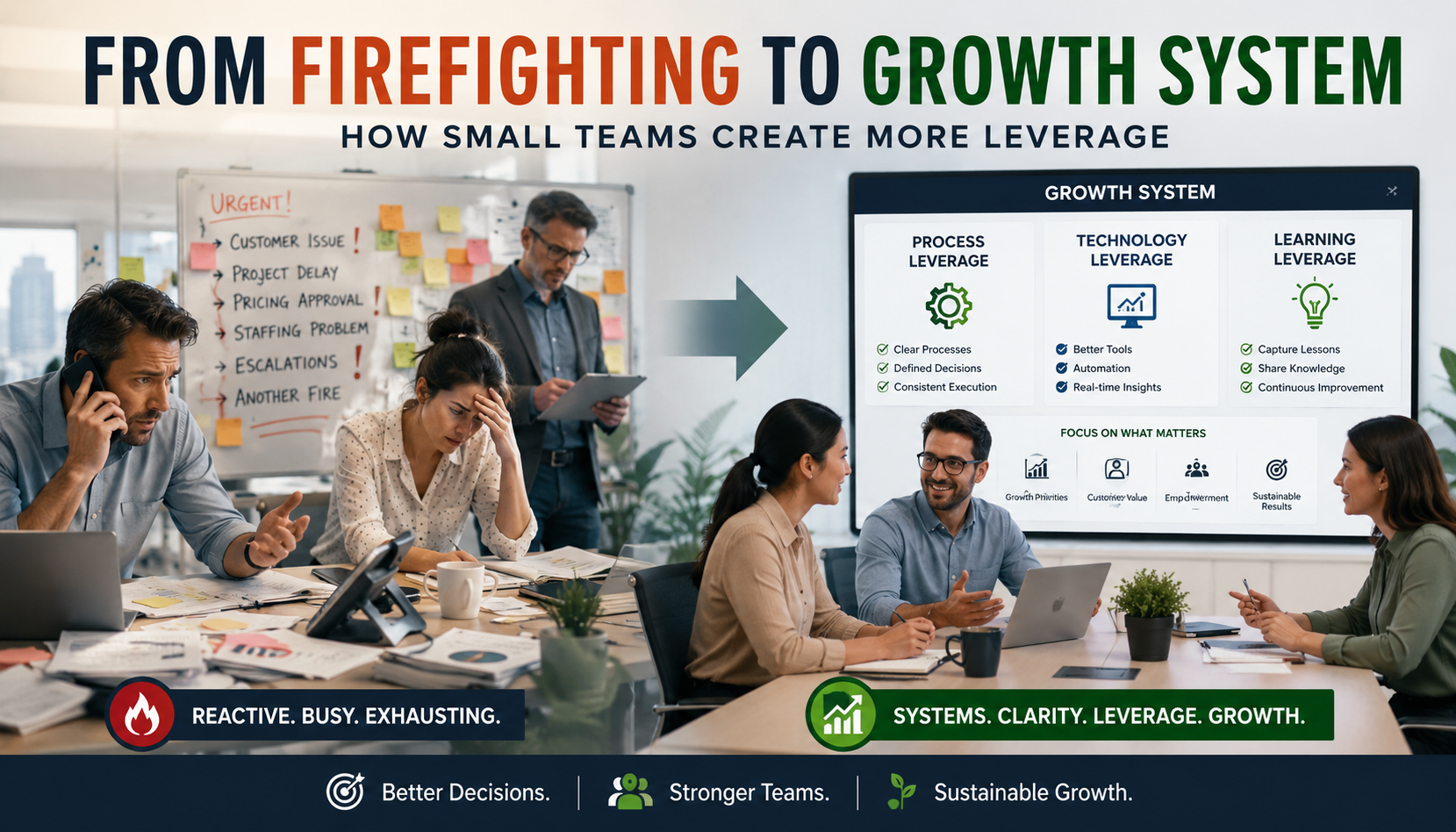
Small teams often reach a point where growth becomes harder, not because the opportunity disappears, but because the way the business operates no longer scales.
The founder is pulled into too many decisions. Senior leaders become the default escalation point. Customer issues, hiring questions, delivery problems, sales exceptions, pricing calls, and operating problems all move upward. The business may still be growing, but the team is working harder to capture each next stage of growth.
That is the moment when leaders need to shift from firefighting to business growth systems.
A growth system does not mean bureaucracy. It means creating the processes, decision rules, technology, and learning loops that enable a small team to gain greater leverage. AP Consulting describes a Growth System as a way to bring structure to growth efforts, learn quickly what customers want, iterate on the right product or service offering, prioritize the right projects to achieve the desired impact, and remember the lessons learned.
For SME founders, operators, and executive teams, the goal is simple: reduce dependence on constant senior intervention so the organization can make better decisions closer to the work.
Why Small Teams Get Trapped in Firefighting Mode
Firefighting usually starts with good intentions.
A customer needs an urgent answer. A project is delayed. A key employee leaves. A pricing question needs judgment. The founder steps in, solves the problem, and keeps the business moving.
At first, this flat structure feels efficient. The senior team has the context, authority, and urgency to get things done. Over time, however, this creates a hidden operating model where the business depends on a few people to resolve ambiguity.
The symptoms are familiar:
- The same issues keep coming back.
- Managers wait for leadership approval before acting.
- Processes exist in people’s heads rather than in shared systems.
- Technology is used inconsistently across the team.
- Lessons from wins and mistakes are not captured.
- Growth creates more meetings instead of more capacity.
- Scale feels linear to leadership time.
This is not a people problem. It is usually a system problem.
Initially, businesses often grow through speed, flexibility, and informal communication. Those strengths matter. But as complexity increases, informal coordination starts to break down. The business needs a clearer way to decide, execute, measure, and improve.
That is where Strategies and Growth Systems become important.
What Business Growth Systems Actually Do
Business growth systems connect strategy to daily execution.
AP Consulting frames strategy as a set of choices about where a business plays and how it wins. Those choices help leaders deploy resources effectively, communicate priorities, and help employees understand how they advance the business.
A growth system turns those choices into repeatable behavior.
Instead of asking, “Who can fix this today?” the organization starts asking better questions:
- What decision rule should guide this situation?
- What process should handle this without escalation?
- What tool can reduce manual work or improve visibility?
- What did we learn that should change how we operate next time?
This shift matters because leverage is not just about doing more. It is about creating an operating model where each person, process, and tool contributes more consistently to the company’s growth priorities.
A business growth system turns strategy from a leadership conversation into a repeatable operating rhythm.
Process Leverage: Make the Right Work Repeatable
Process leverage is created when the business can deliver consistent outcomes without reinventing the work every time.
This does not mean documenting everything in excessive detail. It means identifying the moments where lack of structure creates delays, rework, or unnecessary escalation.
Examples include:
- Sales qualification rules
- Pricing approval thresholds
- Customer onboarding steps
- Project handoff checklists
- Hiring scorecards
- Weekly operating rhythms
- Issue escalation paths
- Performance review cadences
The point is not to remove judgment. The point is to reserve judgment for the decisions that truly require it.
For example, a founder should not need to approve every small pricing adjustment, every customer onboarding exception, or every project handoff question. But the founder may still need to weigh in on a major strategic account, a new market bet, or a capability investment that changes the direction of the business.
Process leverage creates that separation.
It allows recurring work to flow through clear pathways while preserving leadership attention for decisions with greater strategic weight.
A useful starting question is:
What are the five recurring problems senior leaders should no longer have to solve manually?
That list often reveals where process leverage is most needed.
Technology Leverage: Use Tools to Scale Capacity, Not Complexity
Technology leverage comes from using tools to reduce manual effort, improve visibility, drive consistency, and help teams make better decisions faster.
For many SMEs, the issue is not a lack of tools. The issue is that tools are disconnected, underused, or layered onto unclear processes. A CRM does not create sales discipline by itself. A project management system does not create accountability by itself. AI tools do not create leverage if the team has no clear use case, data discipline, or workflow ownership.
Technology creates leverage when it supports a defined operating need.
For example:
- A CRM can make pipeline health visible before revenue misses occur.
- Workflow automation can reduce manual follow-up.
- Dashboards can show delivery risk before customers complain.
- AI tools can support proposal drafting, customer feedback analysis, research synthesis, meeting summaries, and knowledge work.
- Knowledge bases can reduce repeated questions and reliance on a single experienced employee.
The strongest use of technology is not simply adding another tool. It is improving how work actually moves through the business.
McKinsey’s 2025 AI research makes this point clearly. The firm reports that organizations are beginning to reshape workflows as they deploy generative AI. That workflow redesign has the biggest effect among tested attributes on an organization’s ability to see EBIT impact from gen AI.
That matters for small teams. AI and automation can create leverage, but only when integrated into real business processes.
The better question is not, “What technology should we buy?”
The better question is:
Which recurring bottleneck should technology help us remove?
Learning Leverage: Stop Solving the Same Problem Twice
Learning leverage is what prevents the same problem from happening again.
Many small teams learn informally. A leader notices a pattern. A manager adjusts. A team member remembers what worked last time. But unless those lessons are captured, shared, and converted into process, the business keeps depending on individual memory.
A learning system makes improvement repeatable.
Harvard Business Review’s learning organization framework identifies three building blocks of learning organizations: a supportive learning environment, concrete learning processes and practices, and leadership behavior that reinforces learning.
For SMEs, learning leverage can be simple:
- Hold short after-action reviews after major projects.
- Review lost deals for patterns, not blame.
- Track customer complaints by root cause.
- Compare high-performing and low-performing accounts.
- Convert repeated questions into training material.
- Update playbooks after each meaningful operating lesson.
The goal is to make the business smarter every quarter.
Without learning leverage, the company may still improve, but slowly. With learning leverage, the organization compounds experience.
This is especially important when leaders are making growth decisions under uncertainty. AP Consulting’s article on growth strategy in uncertain times emphasizes that resilient teams make better choices with imperfect information by using practical strategic lenses, disciplined execution, and an operating cadence for reassessment.
Learning leverage gives small teams a way to do that consistently.
How Growth Systems Reduce Senior Intervention
Senior intervention is expensive.
It consumes leadership attention that should be focused on strategy, talent, customer direction, capability building, and future growth. A strong growth system reduces this dependence in four ways.
They Clarify Decision Rights
People move faster when they know which decisions they can make.
Small teams often slow down because authority is unclear. Employees may be responsible for outcomes but lack clarity on when they can act independently.
A useful decision system defines:
- Which decisions can be made by frontline managers
- Which decisions require executive review
- Which thresholds trigger escalation
- Which data points must support a decision
- Which trade-offs matter most
This is where strategy becomes practical. If the company has clear growth priorities, teams can make decisions that align with them.
They Create Operating Rhythm
Firefighting becomes more difficult when issues are discovered too late.
An operating rhythm helps leaders see problems earlier. This can include weekly pipeline reviews, monthly project health checks, quarterly strategy reviews, or recurring customer learning sessions.
The point is not to add meetings. The point is to create a predictable cadence for surfacing the right information, making decisions, and removing obstacles.
A strong operating rhythm reduces surprise. It also helps the team distinguish between urgent noise and strategically important signals.
They Turn Priorities Into Resource Choices
Many small teams have too many priorities and too few resource decisions to make.
A business growth system forces the organization to connect ambition with allocation. If a growth priority matters, it needs an owner, a metric, a cadence, and resources. If it does not have those things, it is not yet a real priority.
AP Consulting’s strategic positioning emphasizes making choices consciously, consistently, and deliberately while deploying resources effectively to address the challenges facing the business.
That is the practical role of a growth system. It keeps strategy from becoming a list of aspirations and turns it into a set of operating choices.
They Make Learning Visible
Senior leaders often remain overly involved because they hold the business's institutional memory.
They remember why a customer matters. They remember why a past initiative failed. They remember which assumptions were wrong last time.
A learning system makes more of that memory visible to the organization.
When lessons are captured and converted into playbooks, dashboards, decision rules, and team rituals, the business becomes less dependent on a few people to interpret every situation.
That creates leverage.
A Simple Growth System Diagnostic for SME Leaders
Leaders do not need to diagnose every part of the operating model at once. They can start with a practical set of questions.
This diagnostic helps leaders identify where leverage is leaking from the business.
A recurring issue is often not just an operational annoyance. It may be evidence that the business has outgrown the informal system that once worked.
From Firefighting to Growth System: What to Build First
The shift from firefighting to growth system does not need to start with a large transformation.
In fact, small teams are often better served by building one practical system at a time.
A useful sequence looks like this:
1. Identify the Recurring Fires
Start by naming the issues that keep pulling senior leaders back into day-to-day execution.
Look for patterns in customer escalations, missed handoffs, pricing exceptions, sales delays, hiring decisions, delivery problems, or internal confusion.
The goal is to see where leadership attention is repeatedly consumed.
2. Separate True Exceptions From Repeatable Work
Not every problem should become a process. Some decisions require judgment because they are unique, strategic, or high stakes.
But many “exceptions” are actually repeatable work without a clear owner or rule.
Separate the two.
True exceptions may still need senior judgment. Repeatable work should be systematized.
3. Define Decision Rights and Escalation Rules
Once the recurring work is clear, define who can decide, when they can decide, and when escalation is required.
This helps managers act with confidence while keeping leadership involved in the right moments.
4. Build the Simplest Process That Improves Consistency
Do not overbuild.
A one-page checklist, a decision tree, a weekly review template, or a shared dashboard may be enough to create the first layer of leverage.
The goal is not perfection. The goal is consistency.
5. Add Technology Only Where It Supports the Process
Technology should come after the operating need is clear.
A tool should reduce friction, improve visibility, automate low-value work, or help the team learn faster. If it does not support one of those outcomes, it may add complexity instead of leverage.
6. Create a Learning Loop
Every new process should improve over time.
That means reviewing what worked, what failed, what confused the team, and what customers revealed. Then the process should be updated.
This is how a small team turns daily experience into a compounding advantage.
How AP Consulting Helps Build Business Growth Systems
AP Consulting helps leaders move from scattered growth efforts to structured growth systems.
That work can include clarifying strategic priorities, defining where the business should focus, building governance around growth efforts, supporting customer learning, and helping teams prioritize the projects most likely to create impact.
The value is not just a strategy document. The value is a working system that helps the team make better decisions, learn faster, and use resources more intentionally.
For a small team, that can mean less firefighting and more leadership capacity for the decisions that shape the future of the business.
Talk with AP Consulting about building a growth system that helps your team reduce firefighting and focus leadership attention on the decisions that matter most.
Conclusion: Leverage Is Built Into the System
Firefighting is often a signal that the business has outgrown informal ways of working.
Small teams do not need bureaucracy. They need clarity, rhythm, and repeatable learning.
Business growth systems create that leverage by connecting process, technology, and learning into a practical operating model. The result is not a company where senior leaders disappear from the work. It is a company where senior leaders are involved in the decisions that truly require their judgment.
That is how small teams create more leverage and build a stronger foundation for sustained growth.