
How Jobs to Be Done Helps Leaders Find Better Growth Opportunities
Growth leaders rarely suffer from a shortage of ideas.
Most leadership teams can name potential new markets, product extensions, customer segments, partnerships, or acquisition targets. The harder question is not “What could we do?” It is “Which opportunities are grounded in real customer demand, and which ones only look attractive from the inside?”
That is where Jobs-to-Be-Done can help.
Jobs to Be Done, often shortened to JTBD, helps leaders understand the progress customers are trying to make in a specific situation. Instead of starting with a product, feature, category, or internal capability, JTBD starts with the customer’s struggle, motivation, desired outcome, and current alternatives.
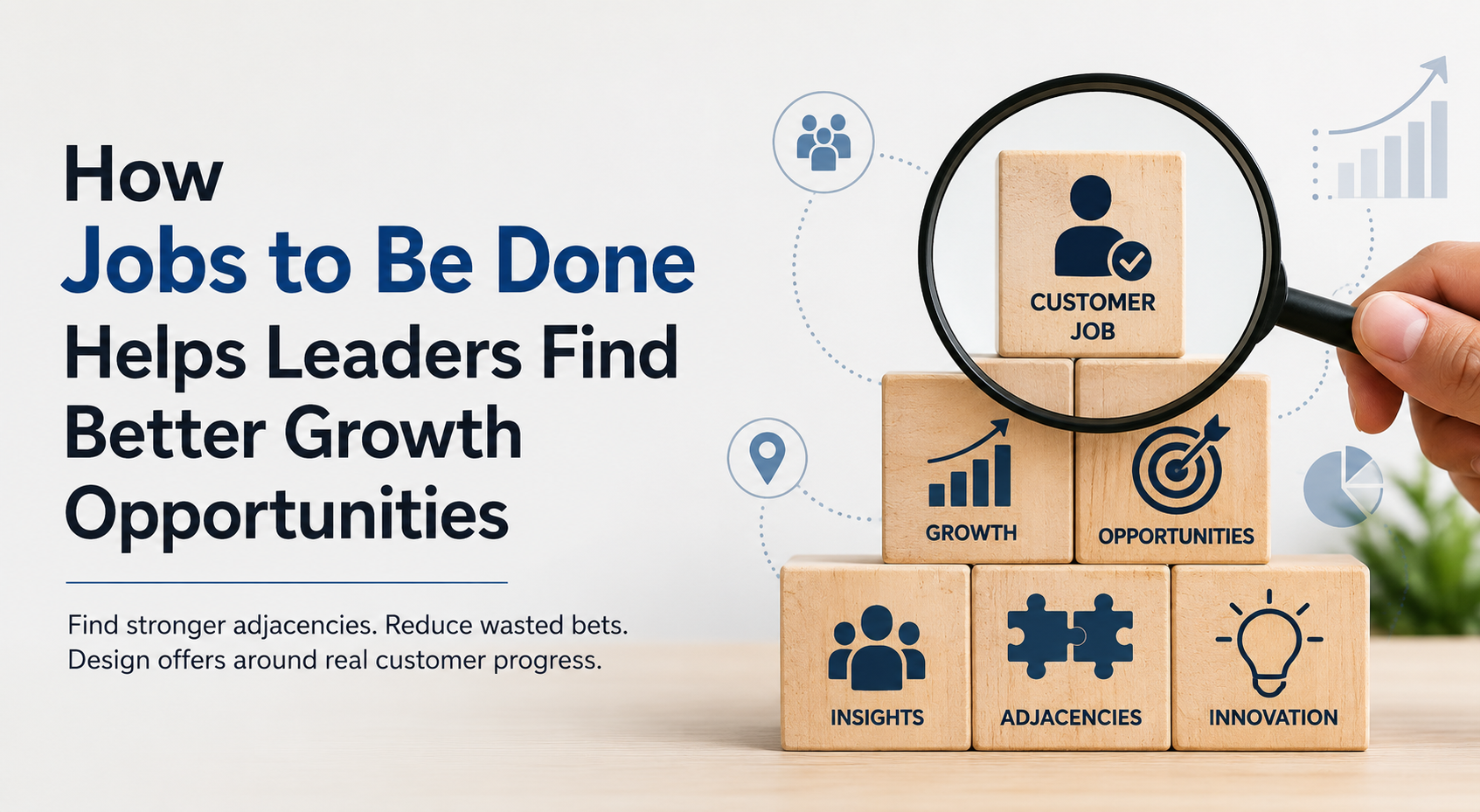
For innovation leaders, product strategists, and founders, this can create a more disciplined way to identify growth opportunities. It can help teams evaluate adjacencies, reduce unfocused bets, and design offers around what customers are actually trying to accomplish.
What Are Jobs to Be Done?
Jobs to Be Done is a customer research and innovation methodology built around a simple idea: customers do not just buy products or services. They “hire” solutions to help them make progress.
That progress may be functional, such as completing a task faster or reducing operational cost. It may be emotional, such as feeling more confident in a decision. It may also be social, such as looking credible to a board, investor, customer, or leadership team.
For example, a company may not simply “buy software.” It may be trying to reduce reporting friction, make decisions faster, improve visibility across teams, or prove to investors that the business has stronger operating discipline.
A Jobs to Be Done lens helps leaders uncover the real context behind the purchase decision:
- What triggered the need?
- What progress is the customer trying to make?
- What alternatives are they using today?
- What trade-offs are they willing to accept?
- What creates anxiety or friction in the decision?
- What would make a new solution clearly better than the status quo?
This is different from asking customers what features they want. Customers may describe features because that is the language available to them. JTBD research goes deeper into the circumstances, motivations, barriers, and outcomes behind the request.
As a practitioner, I fell in love with the method when working at Innosight–a firm founded by former Harvard Business School professor Clayton Christensen. The reason? In addition to being a method, it becomes a language that can be used to describe customers and keep them in the center of conversations around product, strategy, business processes, and even investment cases. This is something that Clayton Christensen, Taddy Hall, Karen Dillon, and David S. Duncan explain in the Harvard Business Review article “Know Your Customers’ ‘Jobs to Be Done’.”
Why Jobs to Be Done Matters for Growth Strategy
Growth strategy requires choices.
Leadership teams must decide where to play, how to win, what to fund, what to stop doing, and where to place bigger bets. Those choices become harder when teams are looking at many possible opportunities at once.
A product team may see a feature extension. A sales team may see a new vertical. A founder may see a new business model. An investor may see a roll-up opportunity. Each idea may have logic behind it, but not every idea reflects a strong customer job.
AP Consulting describes strategy as a set of choices about where a business plays and how it wins. That is also why customer understanding matters so much. A company cannot make strong growth choices if it does not understand the progress its customers are trying to make.
Jobs-to-Be-Done consulting helps bring customer understanding to the center of growth strategy. It gives leaders a way to test whether an opportunity is tied to meaningful customer progress or mainly to internal enthusiasm.
This matters because many growth ideas begin with statements like:
- “We already have the capability.”
- “Competitors are moving into this space.”
- “Customers have asked about this.”
- “The market looks large.”
- “This would be easy to add.”
Those may be useful signals, but they are not enough. A stronger growth opportunity usually has a clear customer struggle, a high-value outcome, a reason to act now, and an opening where existing alternatives are not fully satisfying the job.
JTBD helps leaders look for those signals earlier.
How JTBD Helps Leaders Find Stronger Adjacencies
Adjacency growth can be attractive because it feels close to the current business. A company may take an existing capability into a new market, create a related product, serve a new customer segment, or apply its expertise to a different use case.
But adjacency growth also creates risk.
The new market may not buy the way current customers buy. The problem may look similar from the outside, but it feels different to customers. The company may overestimate the value of its current capabilities. Teams may assume that because they can build or deliver something, customers will care enough to switch.
A JTBD approach helps leaders evaluate adjacencies from the customer’s perspective.
Instead of asking only, “Can we serve this market?” leaders can ask:
- What job is this customer trying to get done?
- Is the job similar to one we already understand?
- Where are current alternatives falling short?
- What would make the customer consider a new option?
- What capabilities do we have that map to this job?
- What would we need to change in our offer, delivery model, pricing, or go-to-market approach?
This distinction is important. A market adjacency is not strong simply because the customer segment is nearby. A product adjacency is not strong simply because the company has the technical ability to build it.
An adjacency becomes more attractive when there is a real customer job that the company is positioned to address better than existing alternatives.
This is also consistent with AP Consulting’s broader view of growth. In its article on developing growth strategies in uncertain times, AP Consulting discusses the need to evaluate growth through practical lenses, including core growth, adjacencies, and disruptive potential.
JTBD and Core, Adjacent, and Disruptive Growth
Jobs to Be Done can support different types of growth decisions. It is not limited to early-stage innovation or new product development. It can help leaders clarify the role of core growth, adjacency growth, and more disruptive opportunities.
This structure helps teams avoid treating all growth opportunities the same.
Core growth often requires better focus and sharper execution. Market adjacencies often require understanding whether the same job exists in a different context. Product adjacencies often require knowing which outcomes customers value enough to justify a new offer. Disruptive opportunities often require understanding customers who are not well served by existing solutions, or who are willing to accept trade-offs for a different kind of progress.
JTBD gives leaders a common language for comparing these paths.
How JTBD Can Reduce Wasted Growth Bets
Jobs to Be Done does not remove risk from a growth strategy. No customer research method can guarantee that a new offer, market entry, or business model will succeed.
What JTBD can do is make learning sharper.
It helps leaders reduce waste by clarifying what must be true for an opportunity to work. Instead of funding a broad idea and hoping the market responds, teams can identify the customer's job. These moments drive demand, shape barriers to switching, and determine the outcomes that matter most.
This can help companies avoid common growth mistakes, such as:
- Building features customers notice but do not value
- Entering markets where urgency is weak
- Mistaking curiosity for demand
- Designing offers around internal capabilities instead of customer progress
- Assuming current customers are always the first customers for new opportunities
- Pursuing too many adjacencies without a clear growth thesis
A JTBD approach also helps leaders separate what customers say from what customers are trying to accomplish. A customer may ask for a specific feature, service, price point, or integration. The deeper question is why that request matters. What progress would it enable? What problem would it remove? What anxiety would it reduce?
That deeper understanding can improve concept testing, offer design, sales messaging, and prioritization.
For companies seeking to build a more repeatable approach to growth, AP Consulting’s business strategy and growth system framing is often used with JTBD. A growth system should help teams learn quickly, iterate on the right product or service offering, and prioritize resources against the most important opportunities.
Jobs to Be Done Is Not a Shortcut
Jobs to Be Done are a powerful tool, but it should not be treated as a shortcut.
JTBD research should be combined with market sizing, competitive analysis, financial modeling, commercial testing, operating planning, and leadership judgment. A strong customer job does not automatically mean a company can win. Leaders still need to evaluate economics, capabilities, timing, competition, and execution risk.
The value of JTBD is not in using the terminology. The value is in disciplined learning and the ability to communicate and disseminate the lessons learned across the organization.
It helps leaders understand why customers make choices, what progress matters, and where the company can create meaningful value. When paired with strategy and execution discipline, JTBD can help teams make more confident growth decisions.
Better Growth Starts With Better Customer Understanding
Growth opportunities are easier to name than they are to choose.
Jobs to Be Done helps leaders slow down at the right moment and ask a better question: What progress is the customer really trying to make?
For innovation leaders, product strategists, and founders, that question can sharpen the way teams evaluate adjacencies, reduce wasted bets, and design offers that connect more directly to customer demand.
AP Consulting helps leadership teams use customer understanding, Jobs to Be Done research, and growth strategy to identify stronger opportunities and translate them into clearer strategic choices.
If your team is evaluating new markets, products, or business models, talk with AP Consulting about using Jobs to Be Done consulting to sharpen your growth strategy and identify better opportunities.