
Integration Velocity: The Overlooked Metric That Makes or Breaks M&A Value
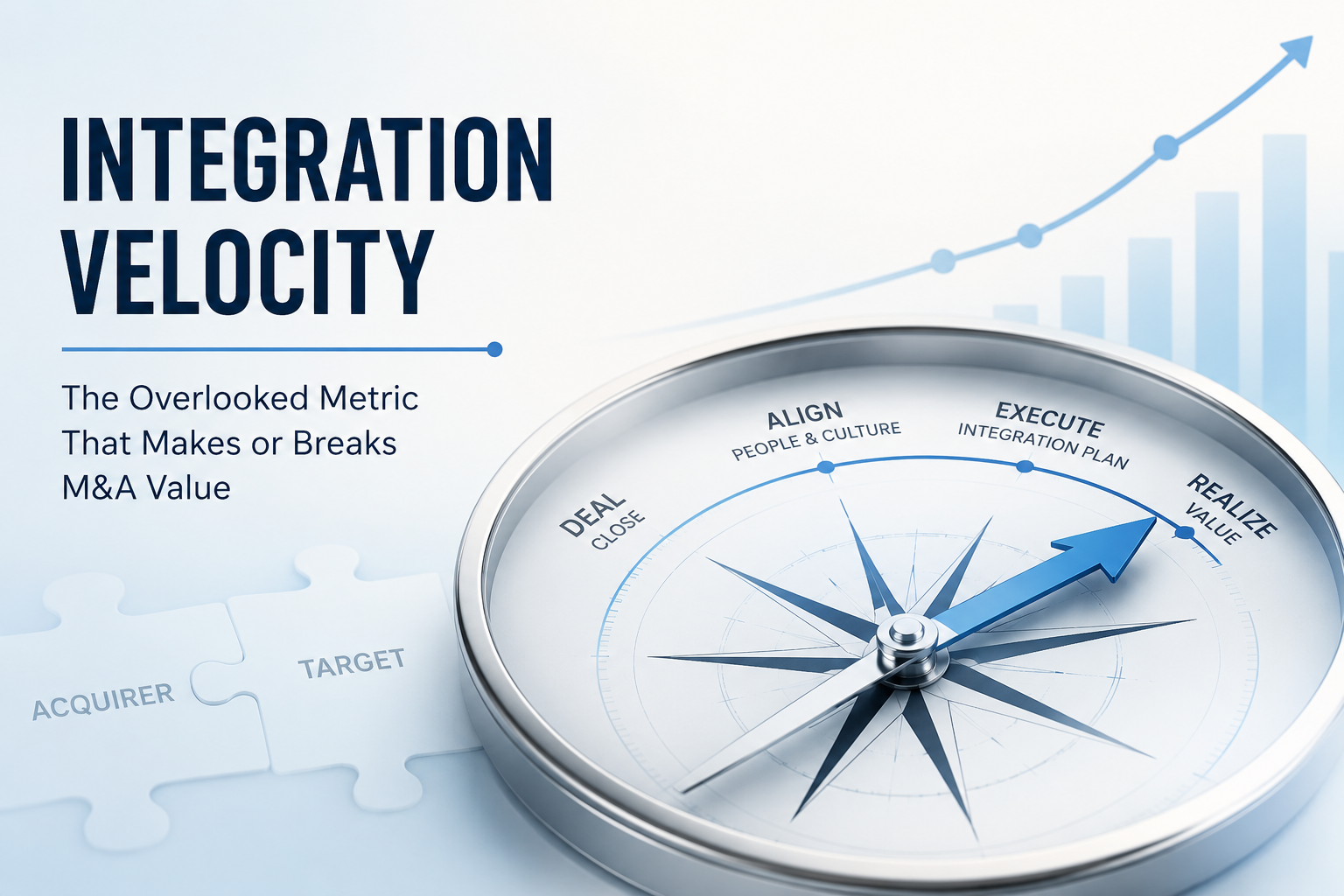
In many acquisitions, the deal model gets the attention, but the integration determines whether the value actually shows up.
A transaction can have a strong strategic rationale, a disciplined valuation, and a clear case for synergy. But after close, value creation depends on whether leaders can translate that thesis into operating reality. That is where integration velocity becomes critical.
Integration velocity is the speed at which an organization can move from transaction logic to coordinated execution without damaging customers, talent, culture, or operating momentum. It is not about rushing every decision. It is about reducing the avoidable drag that slows value creation after close.
For COOs, integration leaders, and private equity operating partners, a strong post-merger integration strategy should answer a practical question: how quickly can the combined business make decisions, align teams, protect customers, retain key talent, and execute the operating plan that justified the deal in the first place?
What Is Integration Velocity?
Integration velocity is not simply the number of days between close and full integration. That definition is too narrow.
A company can move quickly on systems, reporting lines, and branding while still losing momentum where it matters most. Customers may experience confusion. Employees may not know who makes decisions. Leaders may debate priorities that should have been resolved before close. Workstreams may remain busy without advancing the value-creation plan.
A more useful definition is this:
Integration velocity is the rate at which the combined company turns the deal thesis into clear decisions, coordinated behaviors, and measurable operating progress.
That includes:
- How quickly leaders clarify decision rights
- How quickly workstreams understand priorities
- How quickly employees know what is changing and what is not
- How quickly customers experience continuity or improvement
- How quickly synergy assumptions become operating actions
- How quickly cultural friction is identified and addressed
- How quickly the business returns to a steady operating rhythm
This makes integration velocity a management discipline, not just a project timeline.
Why Integration Speed Matters as Much as Deal Economics
Deal economics are assumptions until the organization executes.
A buyer may expect cost savings, revenue growth, cross-selling, purchasing leverage, geographic expansion, or improved management discipline. But those outcomes require coordinated action across people, processes, systems, customer relationships, and leadership routines.
McKinsey’s guidance on merger operating model design notes that it includes structure, process, talent, and behaviors, all of which help an organization deliver on its strategy. That matters because integration is not only a financial exercise. It is an operating exercise.
Slow integration often creates value leakage in ways that do not show up immediately in the deal model.
Common examples include:
- Decision delays that push synergy capture into later quarters
- Duplicated work between legacy teams
- Conflicting customer messages
- Unclear reporting relationships
- Delayed leadership appointments
- Retention risk among high-value employees
- Integration work that distracts from core business performance
The longer these issues remain unresolved, the harder it becomes to maintain momentum. The business may still be integrating, but the window for capturing early confidence can narrow quickly.
This is also why AP Consulting views M&A as part of a broader growth system, not just a transaction event. As discussed in M&A for Growth: Why Serial Acquirers Need a Playbook, Not Just Deal Flow, serial acquirers need a repeatable playbook that connects portfolio logic, diligence, integration governance, and post-merger execution.
The Three Forms of Integration Drag
Integration velocity slows when drag builds inside the organization. In post-close execution, three forms of drag are especially common.
Decision Drag
Decision drag occurs when teams are unclear about who has the authority to decide.
In an integration, this can happen at multiple levels. The executive team may not be aligned on the operating model. Functional leaders may not know where they have authority. Workstream teams may escalate too many decisions because they do not want to create conflict between legacy organizations.
This slows the entire system.
A practical post-merger integration strategy should define:
- Which decisions must be made before Day 1
- Which decisions belong to the executive steering group
- Which decisions belong to functional leaders
- Which decisions can be made by integration workstreams
- Which decisions require input but not consensus
- How unresolved decisions should be escalated
This connects directly to AP Consulting’s perspective on leadership bottlenecks. As discussed in Why Leadership Bottlenecks Kill Growth and How to Remove Them, when decision rights are unclear, leaders become the chokepoint. The result is slower execution, lower accountability, and more frustration across the organization.
Cultural Drag
Culture is often treated as a soft issue in M&A. In practice, it affects speed.
When employees do not understand the intent of the deal, they interpret change through uncertainty. The acquired company may fear loss of autonomy. The acquiring company may assume its processes should become the default. Managers may avoid difficult conversations. Employees may wait to see who stays, who leaves, and whose way of working will prevail.
That uncertainty slows action.
Harvard Business Review’s article on building a unified culture after a merger or acquisition emphasizes that employees are a major part of what made the acquired company attractive in the first place. That point is important. If integration damages the people, habits, relationships, and judgment that created the target’s value, the deal thesis can weaken.
Culture should not be handled as an afterthought. It should be built into the integration plan.
That does not mean forcing sameness. In many deals, the target company is valuable because of its customer relationships, technical capabilities, operating discipline, innovation culture, or entrepreneurial speed. Integrating too aggressively can damage the very capability the buyer wanted to acquire.
The goal is to decide what should be aligned, what should be protected, and what should evolve.
Operating Drag
Operating drag occurs when the business lacks a clear interim model for how work gets done after close.
This can show up in simple but costly ways:
- Sales teams do not know how to coordinate accounts
- Finance teams use different reporting definitions
- Customer service teams follow different escalation paths
- Operations leaders do not know which KPIs matter most
- HR teams cannot answer employee questions quickly
- Technology teams are overloaded with integration requests
The issue is not always a lack of effort. Often, teams work hard but do not operate from the same operating blueprint.
That is why integration velocity depends on more than workstream checklists. Leaders need a clear operating rhythm that connects the deal thesis to daily decisions.
Faster Is Not Always Better
A common mistake is assuming every integration should move as quickly as possible.
Speed matters, but the right pace depends on the deal thesis. Some integrations should move quickly toward standardization. Others should preserve autonomy while selectively aligning the areas that affect value creation.
This is where the integration strategy should connect to the growth strategy.
AP Consulting’s growth framework often separates opportunities across core growth, adjacencies, and more disruptive opportunities. The same logic should apply to M&A integration. A core scale deal, a market adjacency deal, and a capability acquisition should not all be integrated the same way.
For a deeper look at how leaders can balance different types of growth bets, see AP Consulting’s article on How to Balance Core Growth, Adjacencies, and Disruptive Bets.
The question is not, “How fast can we integrate everything?”
The better question is, “Which integration moves will protect and accelerate the value thesis, and which moves could unintentionally weaken it?”
How to Measure Integration Velocity
Integration velocity should be measured. Otherwise, leaders may confuse activity with progress.
A useful scorecard should track speed, quality, and business continuity together. Speed alone can create false confidence. A team can close tasks quickly while creating confusion or damaging the operating model.
Here are practical metrics to consider:
This scorecard should be reviewed regularly by the integration steering team. The purpose is not to create another reporting burden. The purpose is to expose friction early enough for leaders to act.
Deloitte’s perspective on human capital in M&A reinforces that people-related factors such as culture, talent retention, and engagement can have a major effect on whether a deal creates long-term value. That is why integration velocity should not be measured only through financial or operational milestones. It should also account for whether people understand, trust, and can operate within the new direction.
Build Integration Velocity Before Close
Integration velocity begins before the transaction closes.
If leaders wait until after close to define the integration plan, they are already behind. Pre-close planning should clarify the few choices that will shape the first 100 days.
That includes:
- The deal thesis
- The value creation priorities
- What must be integrated quickly
- What should be protected
- The Day 1 operating model
- The target operating model
- Key leadership roles
- Workstream ownership
- Decision rights
- Customer communication priorities
- Employee communication priorities
- Key talent risks
- First 100-day milestones
- Escalation rules
This is why serial acquirers need more than deal flow. They need a repeatable M&A playbook that connects strategy, diligence, integration governance, and post-close execution.
AP Consulting discusses this broader discipline in M&A for Growth: Why Serial Acquirers Need a Playbook, Not Just Deal Flow. A strong playbook does not make every acquisition identical. It gives leaders a common structure for making the right integration choices faster.
The Role of COOs and Integration Leaders
COOs are often the bridge between the transaction thesis and the operating reality.
Their role is to translate strategic intent into the management system of the combined business. That means clarifying how the company will make decisions, serve customers, report performance, allocate resources, and resolve trade-offs.
Integration leaders play a different but related role. They manage the pace and discipline of execution. They should not simply track tasks. They should identify blockers, surface unresolved decisions, connect workstreams, and keep the integration aligned with the value creation plan.
For private equity operating partners, integration velocity is especially important across a portfolio. Each acquisition should improve the firm’s playbook. The goal is not only to make one deal successful. The goal is to build a repeatable capability that helps future acquisitions move faster with less disruption.
This is similar to the broader leadership system described in Building a Repeatable Growth Playbook for the Next Generation of Leaders. Growth becomes more scalable when leaders document how decisions are made, how priorities are translated into action, and how future teams can repeat the process.
Integration Velocity Turns M&A Into a Growth System
M&A value is not created at signing. It is created through disciplined operating choices after close.
The strongest acquirers understand this. They do not treat integration as an administrative phase that begins after the deal team moves on. They treat it as a core part of the growth system.
A strong post-merger integration strategy gives leaders a way to move quickly without moving unthinkingly. It clarifies which parts of the business should be integrated, which capabilities should be protected, which decisions matter most, and how the organization will maintain momentum while change is underway.
Integration velocity matters because time affects confidence. Customers notice confusion. Employees notice uncertainty. Leaders notice unresolved trade-offs. Investors notice delayed value capture.
The faster a business can align around the deal thesis, protect what made the acquisition valuable, and build a clear operating rhythm, the more likely it is to turn M&A from a transaction into sustained growth.
This also connects to AP Consulting’s broader perspective on growth strategy. As outlined in Building a Repeatable Growth Playbook for the Next Generation of Leaders, repeatable growth depends on documented decisions, governance, learning, and operating discipline. The same principle applies to post-close integration.
Conclusion
The overlooked question in many acquisitions is not whether the deal makes sense on paper. It is whether the organization can move quickly enough after closing to realize the value without losing momentum.
Integration velocity gives leaders a practical way to answer that question.
For COOs, it creates a clearer operating agenda. For integration leaders, it turns integration from a checklist into a value-creation discipline. For private equity operating partners, it creates a repeatable capability that can improve execution across multiple acquisitions.
A thoughtful integration plan should balance speed with judgment. Some decisions should be made quickly. Some capabilities should be protected. Some cultural differences should be resolved. Others may be part of what made the acquisition valuable.
The goal is not speed for its own sake. The goal is coordinated momentum.
If your leadership team is preparing for an acquisition or trying to improve post-close execution, AP Consulting can help clarify the deal thesis, identify integration risks, and establish a practical operating rhythm to accelerate post-close momentum.