
Navigating Industry Turmoil Through the Lens of a Small Bike Parts Business

Periods of market turmoil tend to expose the difference between businesses with a clear strategic thesis and businesses that are simply reacting. That is especially true for small companies, where limited capital, narrow margins, and supply chain disruption can quickly turn operational friction into a strategic problem.
At AProto Bike, a small design and manufacturing business I own and operate alongside AP Consulting, that reality became impossible to ignore. The business had been pursuing a growth strategy focused on scaling from custom 3D-printed parts to batch-produced 3D-printed plastics, metal parts, and carbon-fiber components. At the same time, it was operating in a sector where weak demand, debt pressure, and slowing sales were pushing many companies toward layoffs, restructuring, or worse.
That made the business a useful case study in strategic adaptation. The question was not whether the environment was difficult. It clearly was. The question was how to identify the right growth opportunities, choose the right operating metric, and redesign the business model before external pressure undermined momentum.
For us, that metric was burn-multiple. In a growth-stage business funding expansion largely from its own balance sheet, the central challenge is not simply profitability. It is whether cash deployed today creates more future cash flow without damaging the economics needed to sustain growth.
Challenge #1: A Passion Business in a Turbulent Market
The bike industry entered 2025 in a difficult position. Some of the largest players, including Giant and Shimano, reported a roughly 66% decline in profits in their bike businesses while posting only 0% to 3% revenue growth. Several private equity-backed businesses also announced layoffs or restructurings as they sought to pursue growth.
For a small business, those conditions matter. Our goal of continuing 100% year-over-year growth still felt achievable, but it was clear we would not benefit from industry momentum. A more deliberate strategy was needed.
Resolution #1: Focus on Growing Problems
One of the clearest lessons in growth strategy is that businesses serving faster-growing markets, or those with “industry momentum,” are better positioned to outpace average economic growth. Large companies often struggle to grow much faster than the industries they serve. Smaller businesses, or those that have embraced agility and structured themselves accordingly, can do better by focusing on subsegments where demand is rising faster and customer pain points are becoming more acute. That logic is consistent with the strategic framing used across AP Consulting’s core growth work.
In cycling, several pockets of growth stood out. Road bikes were estimated to grow at a roughly 1.5% CAGR, gravel bikes at about 8%, and e-bikes at around 10%. For components, handlebars grew by more than 7% annually. While exact segment definitions vary by source, the pattern was clear enough to guide decision-making.
AProto Bike had already undergone several iterations. The business began as an idea for a bike frame, moved into tool holders and accessories, and then launched custom 3D-printed handlebar and stem adapters. Over time, it became clear that the handlebar category was showing stronger growth than many other parts of the market and that proprietary cockpit systems were creating an increasingly visible customer problem.
That combination, a growing segment and a growing problem, shaped the next phase of product development. From mid-2025 into 2026, the business focused more of its effort on batch-produced handlebar and stem adapters for specific bike platforms and on a gravel-oriented handlebar; both intended to help customers move away from proprietary setups. Instead of broadly chasing the market, we focused on a specific compatibility challenge and subsegment that was growing in value, scale, and complexity.
Challenge #2: Supply Chain Turmoil
Finding the right growth pocket solved only part of the problem. The bigger issue was that the business model itself was coming under pressure.
The first challenge was lead time. In early 2025, products were taking longer to develop and longer to sell. That strained the customer experience and put pressure on burn multiple by tying up cash for longer periods. It also reduced flexibility, leaving less room to invest in new products or build inventory where demand was strongest.
The second challenge was cost volatility. Supplier pricing became increasingly unstable, and in some cases, U.S.-based 3D-printing costs increased by more than 3x between orders. At that point, growth was no longer just harder to manage. It was beginning to damage unit economics.
Taken together, these issues made it clear that incremental adjustments would not be enough. The business needed a structural response.
Resolution #2: Business Model Innovation
At that stage, the options narrowed quickly. The business could either shut down or redesign its operating model to solve for both lead time and cost instability. Three paths emerged.
The first option was to move further upmarket and focus primarily on custom parts. That likely offered pricing upside, but it conflicted with the founding goal of building innovative products that were still relatively affordable. It also created less confidence in sustained growth.
The second option was to offshore production for higher-volume parts while stepping away from custom work. Even with tariffs, unit costs would have been lowered. However, it also would have locked the business into larger orders, higher inventory risk, and longer delivery uncertainty. In practice, it would have improved profit at the expense of burning multiple and portfolio depth, especially because the larger orders would have centered on legacy tool-holder products rather than higher-growth handlebar-related products.
The third option was to focus on the growth portfolio and reposition custom work as product development. This was the option we chose because it directly addressed the internal cost structure while preserving room for continued growth. The plan required five actions:
- Identify new U.S.-based suppliers that could offer lower prices for larger 3D-printing orders and create repeatable production windows.
- Redesign more complex parts to reduce customization and make more products viable for higher-volume production, including metal 3D-printed parts and overseas machining.
- Add fast-turn domestic suppliers at a higher cost to bridge production gaps and support small runs of less popular products.
- Refocus the custom program on models that could be productized and folded into larger, lower-cost production runs.
- Use analytics to determine which products should move from rapid-turn suppliers into scheduled production, improving predictability in both lead times and margins.
This was the most complex option, but it offered the best path to protecting cash flow, improving burn multiple, and preserving strategic flexibility.
Decision: Option #3
The shift took several months to stabilize, but the results were meaningful. By the end of 2025, margins were healthy again, month-to-month revenue growth was running at roughly 8 to 10%, and the business had grown 2.5x year over year.
At a business model level, the change was substantial.
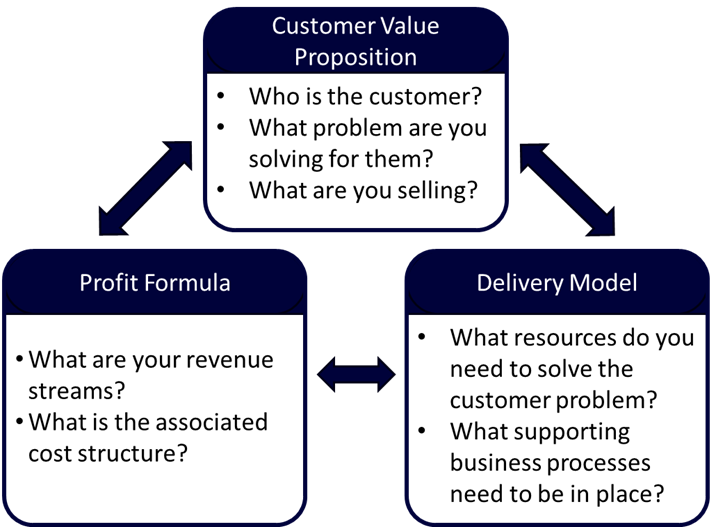
The customer value proposition evolved from providing 3D-printed parts to individual consumers customizing their bikes to serving bike shops, small brands, and consumers seeking compatibility across proprietary systems.
The delivery model shifted from small-batch and custom production sold through Etsy, Shopify, and Instagram to batch and semi-custom products, including 3D-printed plastics, metal parts, and carbon components, sold primarily through Shopify and supported by Google and Meta Ads.
The profit model shifted from simple cost-plus pricing to analytics-driven pricing bracketed by production cost and margin limits, reflecting the business’s commitment to affordability and value.
Conclusion: Fight Turmoil by Embracing Agility
Market turmoil rarely arrives in a single form. Tariffs, tax changes, geopolitical instability, pricing shocks, and policy reversals can all reshape cost structures and planning assumptions within months. Waiting for stability to return is not a strategy. It is a risk.
My experience with AProto Bike reinforced a straightforward lesson. When the environment becomes more volatile, the answer is not to spread resources more thinly. It is to identify where growth still exists, select the metric that matters most, and align the business model around that reality.
In our case, focusing on burn-multiple helped clarify the trade-offs between profitability, growth, lead times, and working capital. That lens made it easier to choose the path that accelerated growth while strengthening resilience.
For businesses facing similar conditions, the broader takeaway is clear. Agility is not just operational. It is strategic. Companies that can identify growth pockets early, respond quickly to shifting economics, and are structured to enable shifts to their business model are better positioned to manage growth in times of turmoil.