
Scenario Planning for 2026: How to Make Better Strategic Choices When Uncertainty Keeps Rising
Uncertainty is no longer a planning exception. It is the planning environment.
For CEOs, strategy leaders, risk managers, and advisory consultants, that changes the job. The question is not how to eliminate uncertainty before making a decision. The question is how to make better decisions while uncertainty remains.
That is where scenario planning consulting earns its place. Done well, it does not create false confidence. It creates better strategic choices, sharper resource allocation, and stronger resilience. That fits AP Consulting’s view of strategy as a set of choices about where to play and how to win, supported by growth systems that help leaders act deliberately rather than reactively.
Why traditional planning struggles when volatility stays high
A standard strategic planning cycle usually assumes a relatively stable environment–and assumes that change happens on the order of years, not months. Teams project demand, estimate costs, allocate capital, and build operating plans around on a yearly basis with the best teams doing an update in Q3 to ensure they hit their targets.
This cadence works far less well when leaders are facing multiple moving variables at once: geopolitical instability, shifting trade rules, AI adoption, labor constraints, uneven customer demand, changing capital costs, and new regulatory pressures. The World Economic Forum’s Global Risks Report 2026 makes the point clearly: leaders are operating in a period of sustained turbulence, not a short, temporary shock.
I’ve noticed that many leadership teams still treat uncertainty as a forecasting problem when it is really a choice problem. Forecasts matter, of course. But when the environment becomes more unstable, the real question becomes: Which decisions remain sound across multiple plausible futures, and which ones need conditions, triggers, or staging?
That is exactly why developing growth strategies in uncertain times requires more than a stronger forecast. It requires a better decision model.
What scenario planning actually does
Scenario planning is often misunderstood. It is not a prediction exercise. It is not about trying to guess which future will happen. It is also not an annual off-site that produces a deck and then disappears into a shared drive.
At its best, scenario planning is a structured way to test strategy against several plausible futures, identify what would have to be true in each one, and decide how the organization should respond before pressure rises. A recent Harvard Business Review article on strategic foresight makes a similar point: organizations that perform well in uncertainty do not just extrapolate trends, they systematically track what is changing and use that insight to guide decisions.
That distinction matters because strong scenario planning improves decision quality in the present. It helps leadership teams avoid overcommitting to fragile assumptions, while also avoiding the opposite mistake of becoming too cautious to act.
Start with the choice, not the scenario.
One of the biggest mistakes companies make is beginning with the scenario itself. They ask, “What could happen?” before they ask, “What decision are we trying to improve?”
The better sequence is the reverse.
Start by identifying the strategic choice that matters most. Is the leadership team deciding how much to invest in a core business line? Should we enter a new market? Should we accelerate AI investment? Whether to pursue M&A? Whether to redesign the operating model? Once that decision is clear, scenario planning becomes useful because it is tied to a real allocation question.
This is where AP Consulting’s strategic lens is especially practical. Across its strategy positioning, About page, and recent content on growth strategy consulting, the firm consistently frames strategy around a clear set of choices and a disciplined approach to execution.
In practice, leaders should separate decisions into three broad buckets:
- Core growth
- Adjacencies
- Disruptive potential
That structure matters because not all bets should be judged the same way.
A core move may need to be judged on margin resilience, payback, service performance, and NPV. An adjacency move may call for staged investment logic, milestone-based funding, and evidence of customer traction. A more disruptive bet often needs a different lens entirely, one that weighs strategic option value, asymmetric upside, and learning velocity rather than forcing the initiative through the same hurdle rate as the core business.
That one shift alone can improve strategic coherence. It stops teams from comparing unlike choices as if they belonged in the same bucket.
A practical scenario planning framework for 2026
Scenario planning becomes far more useful when it is kept simple, disciplined, and decision-oriented. A five-step approach works well for most leadership teams.
1. Define the decision and the time horizon
Be specific. “Improve resilience” is too vague. “Decide whether to pursue aggressive expansion in the Korean market over the next 18 months” is much better.
The time horizon matters because different uncertainties dominate different periods. A six-month scenario set may focus on demand shocks, pricing pressure, and near-term policy changes. A three-year set may focus more on market structure, technology adoption, capability gaps, and portfolio moves.
2. Identify the few uncertainties that matter most
Not every uncertainty deserves equal weight. Strong scenario planning isolates the two or three variables that could materially affect the decision's outcome.
For 2026, common high-impact uncertainties include demand softness versus recovery, tariff or trade shifts, the pace of AI adoption, cost volatility, financing conditions, labor availability, and regulatory change. The WEF risk outlook for 2026 reinforces the idea that leaders are managing overlapping short-term shocks and longer-term structural risks simultaneously.
The discipline here is important. Too many variables create noise. Too few create false certainty.
3. Build three or four plausible futures
Most teams do not need seven scenarios. Three or four is usually enough.
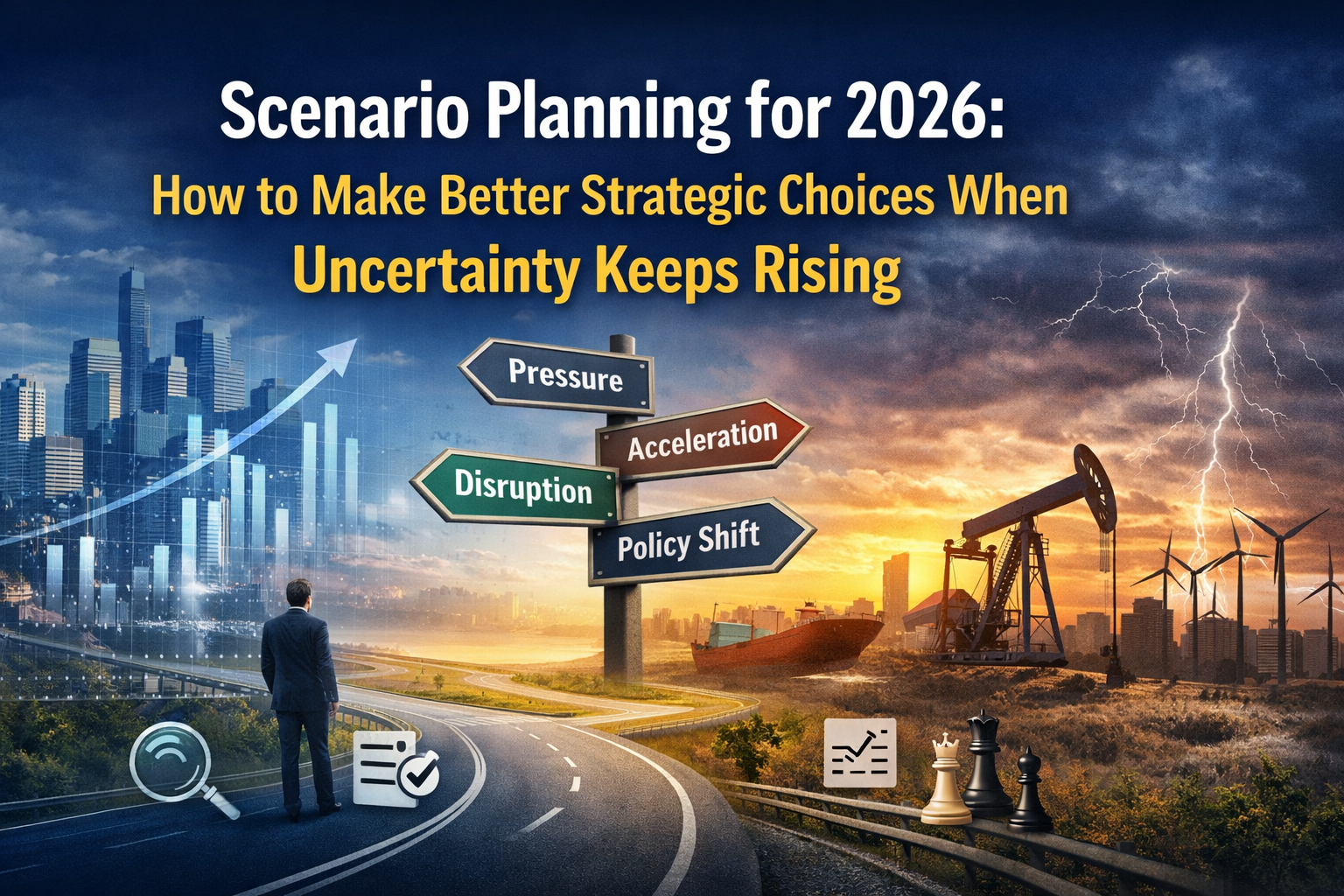
A useful set for many organizations might include a pressure case, where growth stays soft, and margins tighten; an acceleration case, where demand rebounds and investments pay off faster; and a disruption case, where policy, technology, or market shocks force a strategic reset. Some sectors may also benefit from a policy shift case, especially where regulation or global trade rules could materially reshape economics.
The point is not to write fiction. The point is to create plausible environments that force the team to think differently.
4. Stress-test the strategy, not just the numbers
This is where the work becomes valuable.
For each scenario, leadership should test the strategy across a few core questions. Does the value proposition still hold? Does the resource mix still make sense? Are the same capabilities still critical? Would the organization still fund the same portfolio of bets? What becomes more urgent? What becomes less attractive and should be paused? Which assumptions now look fragile and how does that affect our view of risk?
This step often surfaces the most useful insight of all: some actions are no-regret moves that make sense across most futures, others are only attractive under a narrow set of assumptions, and some are critical to ensure the business survives in unfavorable conditions.
5. Turn scenarios into action rules
A scenario planning exercise is incomplete unless it produces concrete choices.
That means leadership should define:
- The moves to make now
- the moves to stage
- The moves to defer
- the signals that would trigger a shift
This is the bridge between strategy and resilience. It gives the organization a way to stay committed without becoming rigid.
Scenario planning should improve resource allocation.
This is the part many teams miss.
Scenario planning is not valuable because it produces interesting conversations. It is valuable because it improves how the business allocates scarce resources. That logic is consistent with how AP Consulting describes structured strategy and the role of a growth system in helping companies prioritize the right projects, learn quickly, and use resources efficiently.
In uncertain markets, that means leadership should ask a tougher set of questions. Which investments strengthen the core no matter what happens? Which adjacency bets should be funded in stages? Which high-risk opportunities deserve a small option stake rather than a full commitment? Which cost actions protect flexibility without starving future growth?
In my experience with strategy work, this is where scenario planning starts paying for itself. It helps teams separate confidence from commitment. You do not need complete certainty to act. You need a better framework for deciding how much to commit, when to commit it, and what evidence should change the plan.
Use signals and triggers, not just annual reviews.
One of the best outputs of scenario planning is a small set of indicators that tell leadership whether reality is moving toward one scenario or another.
These signals should be specific and operational. They might include order velocity, customer churn, backlog quality, pricing realization, hiring cycle times, lead times, commodity costs, regulatory milestones, or competitive moves. Work on emerging critical risks from the OECD and broader executive guidance on the 2026 risk environment both support the value of horizon scanning, early indicators, and structured coordination when uncertainty rises.
This gives the organization something more useful than a static annual plan. It creates a live management system.
Common mistakes that weaken scenario planning
The most common failure is overcomplication. Teams create too many scenarios, track too many variables, and lose the thread. The second failure is abstraction. They discuss risk in broad terms but never connect it to actual choices.
Another frequent issue is treating risk and strategy as separate conversations. Risk teams identify threats. Strategy teams pursue growth. Finance teams protect budgets. Operations teams manage execution. When those conversations stay disconnected, scenario planning becomes ceremonial.
A better approach is integrated. The strategy conversation should include risk, the risk conversation should include choices, and the finance conversation should include optionality.
There is also a subtler mistake: using scenario planning to justify delay. Good scenario work should not make an organization hesitant. It should make the organization more agile and more deliberate.
Teams that want a stronger model for this can learn from AP Consulting’s recent thinking on resilience in uncertainty and on developing growth strategies in uncertain times, both of which push the conversation toward disciplined choices rather than generic caution.
Why this matters for advisory firms, too
For advisory consultants, scenario planning is an opportunity to move beyond generic planning support and become more valuable to the client’s actual decision-making process.
Clients do not need another elegant framework that sits outside capital allocation, portfolio choices, or operating decisions. They need a method that clarifies what to do now, what to watch, and what to prepare.
That is also why AP Consulting’s broader positioning is useful here. The emphasis on building strategic plans that drive growth and efficiency, creating structured strategy, and helping clients sharpen decision-making gives scenario planning a practical endpoint. The goal is not just to imagine multiple futures. The goal is to help clients make sharper decisions.
Conclusion
Uncertainty is rising, but that does not mean strategy should become vague or defensive.
It means leaders need a better way to choose.
Scenario planning, done well, helps leadership teams pressure-test assumptions, improve resource allocation, identify no-regret moves, and prepare for change without waiting for perfect clarity. It does not eliminate uncertainty. It makes the organization more capable within itself.
That is the real value. Better choices. Better timing. Better resilience.
For leadership teams that want to strengthen strategic decision-making in 2026, scenario planning is no longer a nice-to-have. It is one of the clearest ways to turn uncertainty from a source of drift into a source of discipline.
If your team is rethinking how to grow through volatility, AP Consulting AI can help you translate uncertainty into clearer strategic choices, sharper growth priorities, and more resilient execution. A good place to start is a conversation using the strategy tool or a discussion about the right growth-system diagnostic for your business.