
The Choice Stack: A Better Way to Clarify Where to Play and How to Win
Many companies do not suffer from a lack of ambition. They suffer from too many disconnected priorities.
The leadership team may agree that the business needs to grow, improve margins, serve customers better, enter new markets, or become more efficient. But when those goals are translated into budgets, hiring plans, product roadmaps, sales targets, and operating rhythms, the strategy can become unclear.
This is where strategy consultants show their value. At their core, strong strategy consultants often follow a similar process, whether they come from an MBB firm or a high-end boutique.
- Diagnose: Frame the problem, clarify the gap between the business’s current state and the objectives of key leaders or stakeholders, and build the issue tree to understand decision priorities.
- Map: Understand the present business environment, identify white space, and characterize the most relevant opportunities.
- Choose: Use the diagnosis and market understanding to present strategic choices, pressure-test options, and guide leaders toward a set of choices that meet their objectives.
- Govern and communicate: Test the strategy, structure governance meetings, and communicate the draft strategy to gain buy-in.
- Make the case: Develop storylines, financial models, board presentations, and other materials to clearly explain the strategy
After this, many teams assume they are ready for execution.
Or are they?
Having done this work for more than 16 years, we have seen how the assumption that strategy is a simple linear process can hurt teams. When each step is treated as equally important, leaders can end up with a polished strategy that does not work in practice.
That is where the Choice Stack becomes useful.
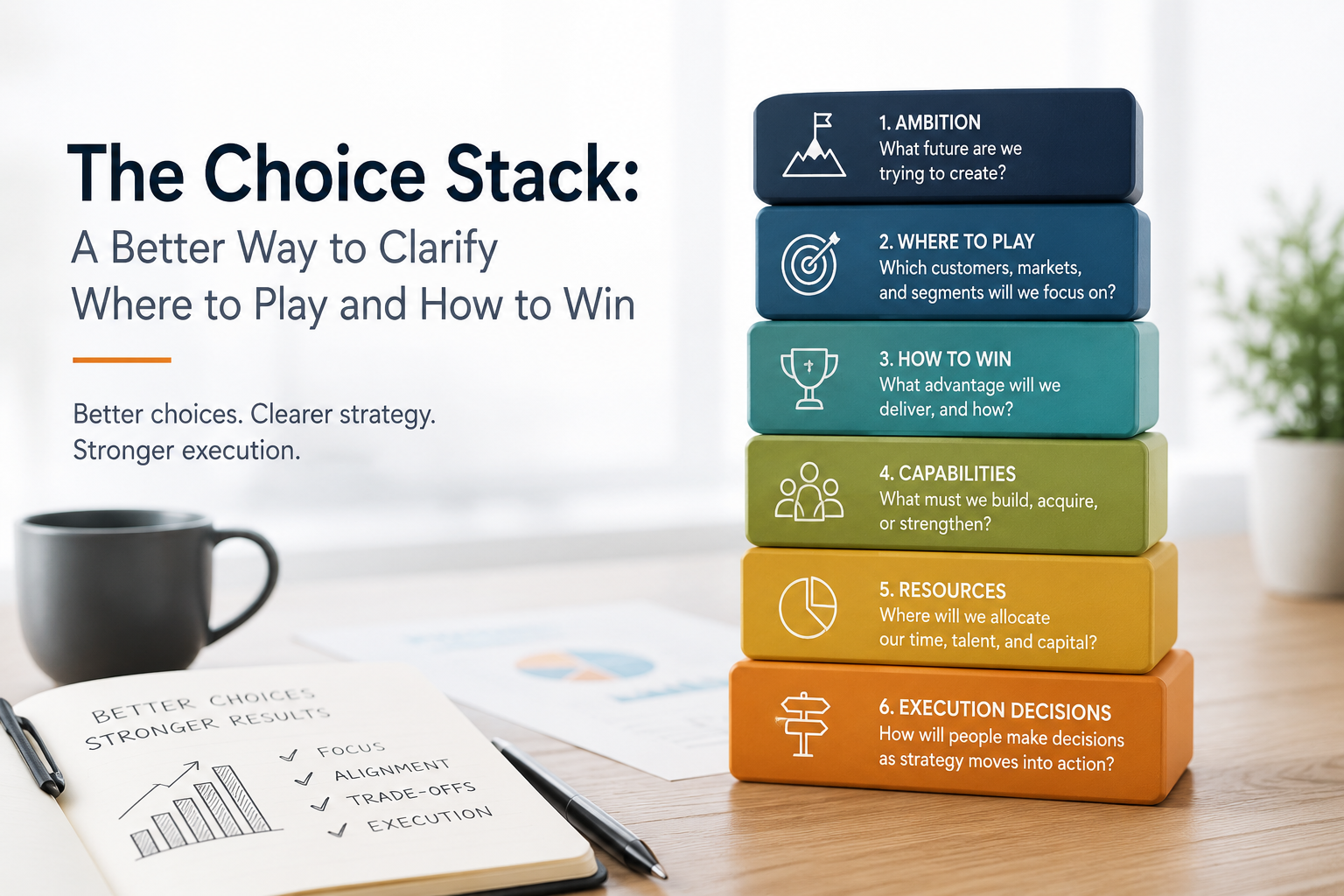
The Choice Stack creates a logic hierarchy and helps leaders understand dependencies across the business. It is a practical way to organize strategy as a connected set of decisions. It helps leaders clarify where the business will focus, how it will compete, what capabilities it needs, how resources should be allocated, and how people should make decisions once the strategy moves into execution.
For CEOs, strategy leaders, and business owners, this kind of clarity can make the difference between a plan that sounds good and a strategy the organization can actually use.
For companies exploring business strategy consulting, the most valuable work is often not creating a longer strategy document. It is helping the leadership team make sharper, better-connected choices.
What Is the Choice Stack?
The Choice Stack is a structured way to connect the most important strategic decisions a business must make.
Instead of treating vision, market selection, competitive advantage, capabilities, resources, and execution as separate planning topics, the Choice Stack puts them in sequence and shows how each decision affects the next.
A practical Choice Stack answers ten questions:
What is our ambition?
- Where will we play?
- Which customers are most important?
- Which markets are the best fit?
- Which opportunities should we prioritize?
- Which segments should we prioritize?
- How will we win?
- What capabilities must we build, acquire, or strengthen?
- Where should we allocate resources?
- How will people make decisions as the strategy moves into execution?
The value of the stack is not the list itself. The value is in the connection between the choices.
The value of the stack is not the list itself. The value is in the connection between the choices. The structure shows how questions affect others—and which ones are higher order. It implies that, as you answer sub-questions, you need to consider whether the answer affects those of higher order. It demands that strategists iterate to ensure the answer is clear, consistent, and executable.
A company cannot define the right capabilities without knowing how it plans to win. Similarly, a change in capabilities can change the company’s possible ways to win. Managers cannot execute a strategy that contradicts itself.
To managers and employees who execute a strategy, the Choice Stack makes connections visible, clarity achievable, and consistency more natural. This is the difference between a strategy that sits on the shelf and one that creates value.
Why Strategy Needs More Than a Vision Statement
A vision statement can create direction. It can inspire people and describe the future the company wants to build. But vision alone does not tell a team what to prioritize on Monday morning.
Strategy requires boundaries.
A leadership team needs to define which customers matter most, which markets deserve investment, which capabilities are essential, and which opportunities should be declined. Without those boundaries, teams often default to activity. They launch more initiatives, chase more segments, respond to more urgent requests, and stretch the same resources across too many priorities.
That is one reason operational improvement is not the same as strategy. A company can become more efficient and still lack a clear position in the market. It can execute quickly and still execute against too many directions at once. Harvard Business Review’s classic article What Is Strategy? makes this distinction clear: operational effectiveness matters, but it does not replace strategic choice.
The Choice Stack helps leadership teams move from broad intent to focused action. It turns strategy from a statement into a set of practical decisions.
The Choices in the Choice Stack
The ambition choice
The first choice defines what success should look like.
This does not need to be a vague aspiration or an unrealistic growth target. It should be specific enough to guide decisions. For example, a company may choose to become the preferred partner for a defined customer segment, build a stronger recurring revenue base, expand into a higher-growth market, or improve profitability by narrowing focus.
The ambition choice should answer one question clearly:
What future are we trying to create, and why does it matter?
Without this choice, strategy discussions can quickly become a debate about tactics. With it, leaders have a shared reference point for evaluating options.
1. The where-to-play choice
The where-to-play choice defines the arena.
This includes decisions about customer segments, industries, geographies, channels, use cases, price points, and problems the company will focus on. It also includes the choices the company will not pursue.
This is often where strategy becomes uncomfortable. Many businesses want to keep options open. They do not want to say no to a customer group, market, or opportunity. But if everything remains in scope, the organization has no real strategic boundary.
A clear where-to-play choice answers the following component questions:
1.1. Which customers are most important to our future?
1.2. Which markets have the strongest fit with our capabilities?
1.3. Which opportunities should we prioritize for leadership attention?
1.4. Which segments should we prioritize, and which are distracting?
This is also where understanding the customer becomes essential. AP Consulting’s work emphasizes the importance of understanding customer needs, motivations, and jobs to be done so companies can make better growth decisions.
2. The how-to-win choice
Once the business defines where it will play, it must clarify how it expects to win there.
This choice is not a slogan. It is the logic behind why customers should choose the company over alternatives. The answer may involve speed, technical expertise, customer intimacy, cost position, integration capability, service quality, product performance, or a more focused business model.
The key is fit.
A company cannot claim every advantage at once. A low-cost strategy requires different choices than a highly customized service model. A technical specialization strategy requires different investments than a broad-market scale strategy.
Roger Martin’s Strategy Choice Cascade makes a similar point: where to play, how to win, capabilities, and management systems should work together. The how-to-win choice is only credible when the company can build the capabilities, resource commitments, and decision systems needed to support it.
The how-to-win choice should answer three connected questions.
2.1. What capabilities must we build, acquire, or strengthen?
Capabilities are the things the business must be able to do well to deliver its strategy.
If the strategy depends on consultative selling, the business needs the right sales talent, training, tools, and customer insight. If the strategy depends on operational speed, it may need stronger process discipline, better systems, and clearer decision rights. If the strategy depends on innovation, it may need better customer research, concept testing, and product development routines.
This is where many strategies become practical. If the required capabilities are missing, underfunded, or unclear, the strategy may remain aspirational.
2.2 Where should we allocate resources?
Strategy becomes real when resources move.
A business can say a market is important, but if the budget, talent, leadership attention, and operating cadence do not shift, the organization will notice the gap. Teams pay attention to what leaders fund, measure, and discuss.
The choice of resource defines where the company will place its bets.
This may involve reallocating capital to a growth market, assigning stronger talent to a strategic initiative, reducing investment in low-priority areas, or changing how leadership reviews progress.
A useful resource choice should make trade-offs visible. It should help leaders decide what to fund, what to delay, what to stop, and what to protect.
2.3 How will people make decisions as the strategy moves into execution?
This is the part of the how-to-win choice that often determines whether the strategy becomes useful.
A company may know where it wants to play and how it wants to win, but execution depends on hundreds of decisions that happen outside the leadership meeting. Sales teams decide which prospects to pursue. Operations leaders decide which service levels to protect. Product and service teams decide which customer problems deserve attention. Finance leaders decide which investments deserve funding. Managers decide when to escalate and when to act.
If the strategy does not give these people a clear decision logic, execution slows down. Teams wait for approval. Functions interpret priorities differently. People continue old habits because the new boundaries were never translated into working rules.
A strong how-to-win choice should help people answer questions such as:
- Does this opportunity fit the customer and market choices we made?
- Does this investment strengthen the advantage we are trying to build?
- Does this request support our chosen capabilities, or does it distract from them?
- Should this decision be made locally, escalated, delayed, or declined?
- What trade-offs are acceptable because they support the strategy?
This is where the Choice Stack moves from strategy design to management practice. It should shape meeting agendas, investment gates, operating metrics, performance conversations, and communication routines. The goal is not to control every decision from the top. The goal is to give managers enough clarity to make consistent decisions without waiting for executive approval every time.
When people understand the logic of the strategy, they can act with more confidence. They know what matters, what does not, and how their choices connect to the company’s broader direction.
How the Choice Stack Improves Resource Allocation
Resource allocation is one of the clearest tests of strategy.
When strategy is unclear, leaders often spread resources across too many initiatives. Every opportunity has a sponsor. Every department has a priority. Every project can be defended. But the business may not have enough capacity to execute all of them well.
The Choice Stack creates a better filter.
It helps leadership teams evaluate whether an initiative supports the company’s chosen ambition, market focus, competitive advantage, and capability needs. If it does not, the initiative may still be interesting, but it may not deserve scarce resources.
For growth-focused companies, this matters across different types of opportunities:
This connects closely with AP Consulting’s thinking on developing growth strategies in uncertain times, where core growth, adjacencies, and disruptive potential require different levels of risk, investment, and management attention.
The point is not to avoid risk. The point is to allocate resources based on the type of bet being made.
Why Integrated Choices Help Managers Execute
A strategy is only useful if it improves decisions below the executive level.
In many organizations, senior leaders understand the strategy because they were involved in creating it. Managers and employees, however, often receive the strategy as a presentation. They may hear the goals, but not the trade-offs behind them.
That creates execution friction.
Managers hesitate because they are unsure what matters most. Teams escalate decisions that should be made closer to the work. Functions interpret priorities differently. People continue old habits because the new boundaries were never made clear.
The Choice Stack helps reduce that confusion by translating strategy into decision logic.
For example, if the company has chosen a specific customer segment, sales teams can qualify opportunities more consistently. If the company has chosen a service-led advantage, operations can understand why responsiveness matters. If the company has chosen to protect margin over volume in certain segments, finance and commercial teams can make better pricing decisions.
This is where AP Consulting’s practical approach is especially relevant. Strategy should not become a 100-page document that sits on the shelf. It should help leaders communicate priorities in a way the organization can use.
Common Signs Your Strategy Choices Are Not Stacked
Many companies already have pieces of a strategy. The problem is that the pieces do not always fit together.
Here are common signs that the Choice Stack needs work:
- Leaders agree on growth goals but disagree on which markets matter most.
- Every initiative sounds important, even when resources are limited.
- Sales, operations, finance, and product teams define priorities differently.
- The company says it wants to focus, but continues to fund too many small bets.
- Managers wait for executive approval because decision boundaries are unclear.
- Budget decisions follow historical patterns instead of strategic priorities.
- Strategy conversations focus on initiatives before clarifying customer and market choices.
- The company has a plan, but day-to-day behavior has not changed.
These symptoms do not always mean the strategy is wrong. They may mean the strategy is incomplete, unclear, or not connected to execution.
How We Can Help
The value of business strategy consulting is not simply bringing in an outside framework. The value is helping leadership teams make difficult choices with more structure, discipline, and objectivity.
A strong consulting engagement can help leaders:
- Surface assumptions that are shaping decisions.
- Compare growth options more clearly.
- Define where the business should focus.
- Clarify how the company can win in the chosen markets.
- Identify the capabilities required to execute.
- Connect strategic choices to budgets, talent, and operating rhythms.
- Build communication tools that help managers act with confidence.
This work is especially important when a company has multiple attractive paths. Growth can create complexity. New markets, new products, new customer types, and new partnerships can all look promising. Without a clear Choice Stack, leaders may chase too many of them at once.
AP Consulting helps companies build practical Strategies and Growth Systems that connect choices to action. The goal is not strategy for its own sake. The goal is to help leadership teams decide what matters, align around those decisions, and give the organization a clearer path to execute.
The Choice Stack Makes Strategy Easier to Use
The Choice Stack does not make strategy easy. Leaders still have to make trade-offs. They still have to test assumptions. They still have to decide what not to do.
But it does make strategy easier to use.
It gives the leadership team a common structure for discussing choices. It helps connect ambition to markets, markets to advantage, advantage to capabilities, capabilities to resources, and resources to execution. Most importantly, it helps people across the business understand how their decisions support the company’s direction.
Clearer choices create clearer boundaries. Clearer boundaries improve focus. Better focus can help teams use time, capital, and talent more effectively.
If your organization has strong goals but too many competing priorities, the next step may not be another planning cycle. It may be a clearer Choice Stack.
Speak with AP Consulting about clarifying your strategic choices and building a growth system your team can execute.