
Why Revenue per Employee Matters More as a Business Scales
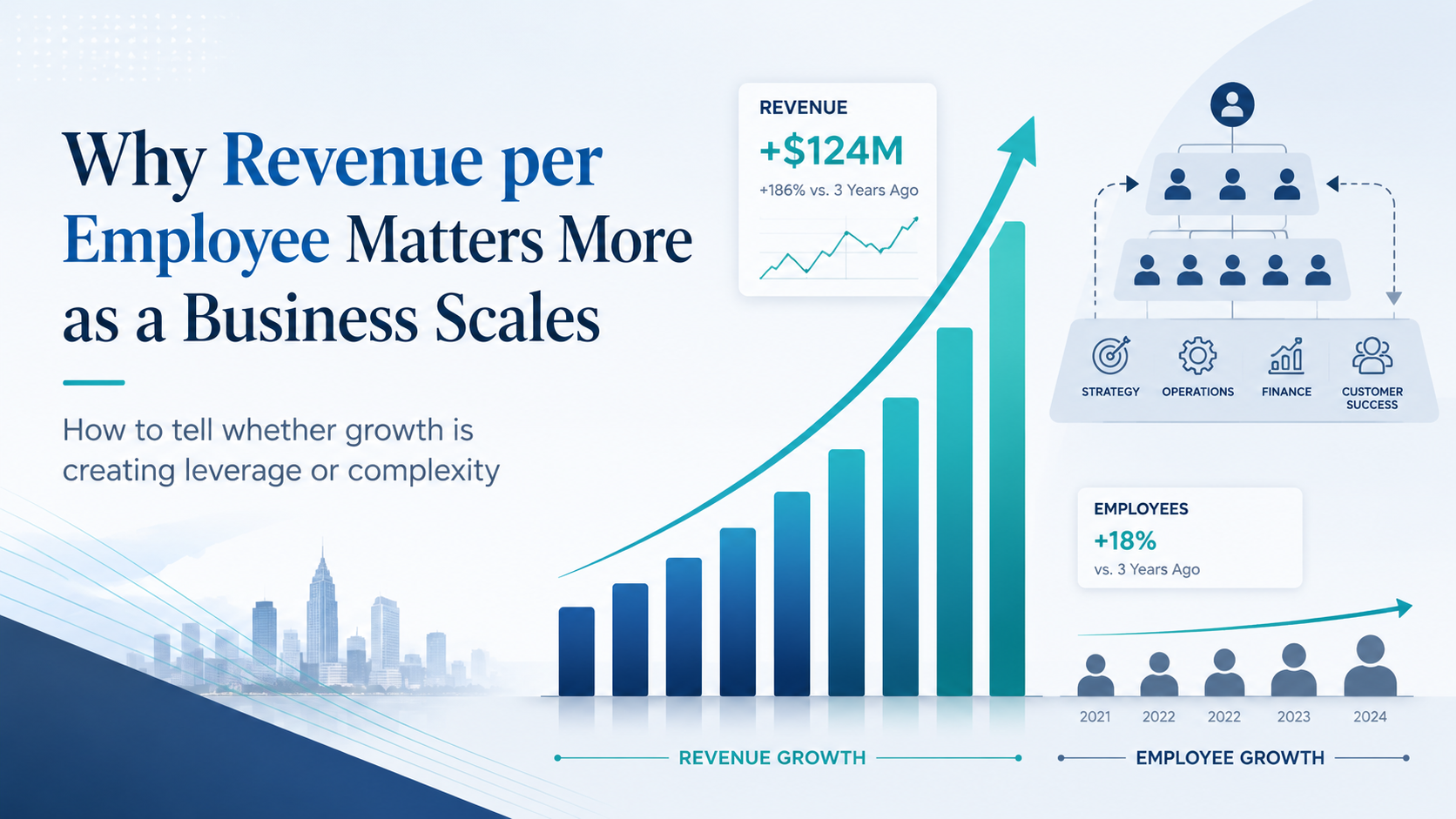
Revenue growth can make almost any business look healthier.
A company grows from $20 million to $40 million in revenue. Customers are buying. New people are joining. Functions are becoming more specialized. Managers are being promoted. New systems are being implemented.
From the outside, the company has doubled.
But suppose headcount increased from 40 employees to 100 during the same period. Revenue doubled, while the organization became two and a half times larger.
That does not necessarily mean something is wrong. The company may be investing ahead of future demand, building capabilities it previously lacked, entering new markets, or preparing for another stage of growth.
But it does raise an important leadership question:
Is the business creating more capacity as it scales, or does each additional stage of growth require roughly the same increase in people, management, and organizational complexity?
This is where revenue per employee becomes useful.
Revenue per employee should not be treated as a score that management tries to maximize. Nor should it become an excuse for indiscriminate headcount reduction. Used appropriately, it is a diagnostic that can help founders, CEOs, COOs, and private equity-backed leadership teams understand whether growth is creating operating leverage.
As a company becomes larger, that question becomes increasingly important. It also becomes more important to ensure the company has built the foundations required to absorb additional scale, rather than allowing new revenue to amplify weaknesses in processes, decision-making, and coordination.
What Revenue per Employee Actually Measures
At its simplest, revenue per employee can be calculated as:
Revenue per Employee = Revenue ÷ Average Number of Employees
For internal analysis, using average headcount or full-time equivalents over the measurement period can provide a more useful comparison than simply dividing annual revenue by the number of employees on the final day of the year. Whatever method the company chooses, consistency across periods is important.
The calculation is simple.
Its interpretation is not.
Revenue per employee is sometimes described casually as a productivity metric, but leaders should be careful with that terminology. The U.S. Bureau of Labor Statistics defines labor productivity as output relative to the labor hours required to produce it. In other words, formal labor productivity measures output per hour rather than company revenue per employee.
That distinction matters.
Revenue can change because of:
- Pricing
- Product or customer mix
- Acquisitions
- Market demand
- Inflation
- Outsourcing
- Capital investment
- Sales effectiveness
- New technology
- Changes in employee utilization
A rising revenue-per-employee figure therefore does not prove that individual employees suddenly became more productive.
Likewise, a decline does not automatically mean employees are performing poorly.
The metric is better interpreted as a question:
How is the relationship between the size of our business and the size of the organization required to operate it changing?
That makes revenue per employee a signal rather than a verdict.
Why Revenue per Employee Matters More as a Business Scales
Small companies often run on informal coordination.
A founder can speak directly with sales, operations, finance, and product leaders. Problems can be resolved through a conversation. Employees know whom to ask when something unusual happens. Processes may exist largely through experience rather than formal systems.
That model has limits.
As businesses become larger, specialization increases. New departments appear. Responsibilities become distributed across more people. Managers supervise managers. Customer work crosses more functional boundaries. Once obvious decisions can require meetings, approvals, data, or escalation.
AP Consulting's earlier strategy work describes the same tension. Larger companies have more organizational levels, creating greater opportunities for leverage but also more opportunities for communication to break down when the organization lacks sufficient strategic clarity.
Growth therefore introduces two possibilities.
The first is leverage.
The organization builds processes, technology, management systems, capabilities, and decision structures that allow more business to flow through the company without requiring resources to increase at the same rate.
The second is organizational drag.
Revenue increases, but every new stage of growth requires additional coordinators, administrators, managers, meetings, approvals, and workarounds. Complexity absorbs the capacity that growth was supposed to create.
This distinction is central to AP Consulting's broader thinking on moving from firefighting to a business growth system. A growth system should help organizations reduce repeated senior intervention by creating process leverage, technology leverage, clearer decision rights, and mechanisms for organizational learning.
Revenue per employee can provide one economic lens into whether that leverage is beginning to materialize.
Revenue Growth vs. Headcount Growth: Four Patterns Leaders Should Watch
The absolute revenue-per-employee number is usually less useful than its movement over time.
A technology company, distributor, professional-services firm, manufacturer, and field-service organization naturally require very different amounts and types of labor.
Instead of asking, "What should our revenue per employee be?" leadership teams can start with a better question:
What is happening to revenue relative to the organizational resources required to support it?
None of these patterns provides a conclusion by itself.
Consider the third situation.
A business growing headcount faster than revenue could be experiencing process inefficiency. But it could also have hired a sales team six months before expecting revenue, opened a facility with excess capacity, built an engineering organization for a new product, or added leadership required for the next stage of scale.
The number identifies the pattern.
Management still has to understand the cause.
Falling Revenue per Employee Might be OK
One of the most dangerous uses of revenue per employee is treating every decline as evidence that costs need to be removed.
Growth frequently requires companies to build capacity before that capacity produces revenue.
A business may deliberately lower revenue per employee while it:
- Builds a sales organization for a new market
- Opens a new geography
- Adds engineering or product-development capabilities
- Professionalizes finance and reporting
- Implements a new ERP or operating platform
- Expands manufacturing capacity
- Builds a new management layer
- Integrates an acquisition
- Develops capabilities required by larger customers
These investments can create a temporary gap between headcount growth and revenue growth.
The more useful question is not whether revenue per employee declined.
It is:
What future capability was the additional organizational capacity intended to create, and is that capability beginning to deliver the expected results?
That question forces leadership to connect hiring with strategy.
Suppose a company increases its sales organization by 40 percent. Revenue per employee may initially fall. If the investment creates a stronger pipeline, higher-quality market coverage, and eventually faster revenue growth without another proportional increase in sales headcount, the temporary decline may have been part of building leverage.
If the same organization grows for three years while revenue increases only in proportion to additional salespeople, leadership may need to investigate the commercial model itself.
The distinction becomes particularly important following acquisitions. AP Consulting's work on integration velocity and post-merger value creation emphasizes moving from transaction logic to coordinated operating execution while avoiding unnecessary drag on customers, talent, culture, and operating momentum.
Adding two organizations together may increase revenue immediately. It may also introduce duplicate systems, roles, decision structures, and processes.
Revenue per employee can help surface the issue, but understanding integration quality requires looking underneath the ratio.
What Creates Sustainable Revenue per Employee Numbers?
Sustainable revenue per employee does not simply come from asking fewer people to do more work.
The stronger form of leverage occurs when the organization becomes more capable.
Several mechanisms can create that capacity.
Strategic Focus
Companies consume enormous amounts of capacity when priorities are unclear.
Teams pursue too many customer segments. Products remain in the portfolio without clear strategic roles. Initiatives compete for resources. Functional leaders optimize locally because enterprise-level trade-offs have not been resolved.
A clear strategy establishes where the company will play, how it intends to win, and which opportunities deserve resources.
That allows the business to direct its existing capacity toward fewer, more meaningful priorities.
Process Leverage
Some work increases naturally as revenue increases.
Other work increases because the process was never designed to scale.
A company processing twice as many customer orders should expect additional operational activity. It should not automatically expect twice as many approvals, reconciliations, spreadsheets, handoffs, or management interventions.
Process leverage comes from separating work that genuinely scales with volume from work created by poor workflow design.
Technology Leverage
Technology creates leverage when it removes repetitive effort, improves access to information, reduces errors, or allows employees to manage a larger volume of work.
But installing software does not create leverage by itself.
A company can digitize a poor process and preserve nearly all of its underlying complexity. It can increase the capacity of some employees to do specific tasks, but still retain bottlenecks that drive poor overall utilization.
Leadership should therefore evaluate technology investments based on the organizational capacity they create, not simply whether a new system has been deployed or if a specific set of tasks now takes less time.
Decision Leverage
Growth becomes expensive when decision authority does not grow with organizational capability.
If routine customer decisions, spending approvals, staffing questions, exceptions, and operating choices continue moving upward, senior leaders become part of the company's capacity constraint.
This is the problem AP Consulting examines more deeply in Why Leadership Bottlenecks Kill Growth and How to Remove Them. As organizations grow, decision capacity also has to scale. Otherwise, additional people and systems can be added while important trade-offs remain dependent on the same small group of leaders.
Creating decision leverage means establishing appropriate ownership, guardrails, information, and accountability so capable managers can make decisions without unnecessary escalation.
Learning Leverage
A scalable organization should become better at solving problems it has encountered before.
If every customer issue, project failure, integration challenge, or operational disruption has to be rediscovered from the beginning, the business repeatedly spends capacity on the same learning.
Strong growth systems capture lessons and turn them into processes, standards, tools, or decision rules.
The organization should not merely work harder. It should create capability by learning.
Revenue per Employee Should Never Be Used Alone
Revenue per employee can become dangerous when leadership turns one diagnostic into the objective.
Imagine that a company improves the ratio dramatically while customer service deteriorates, employee turnover increases, quality falls, or margins decline.
The number improved.
The business may not have.
Leadership teams should therefore examine revenue per employee alongside other indicators.
The combination matters.
Revenue per employee may rise while labor cost as a percentage of revenue also rises because the organization has shifted toward more expensive specialized talent.
It may rise because low-value work was outsourced rather than eliminated.
It may rise following a major price increase without any change in underlying operating capacity.
It may also decline while margins improve because the company intentionally shifted toward a business requiring more specialized labor but producing better economics.
Leadership should understand the system, not simply the ratio.
What Private Equity-Backed Leadership Teams Should Watch
Revenue per employee can be particularly useful in private equity-backed businesses because growth plans often combine multiple sources of value creation.
A portfolio company might simultaneously pursue organic growth, professionalization, technology investment, new-market entry, operational improvement, and acquisitions.
Each can affect headcount differently.
Rather than comparing unrelated portfolio companies based on an absolute revenue-per-employee target, operating teams can use the metric to examine the evolution of each business.
Useful questions include:
- What was the revenue-per-employee trend before acquisition?
- What capacity is being added under the value-creation plan?
- Which functions are growing faster than the company?
- Is new management infrastructure eventually reducing executive involvement?
- Are technology investments creating measurable capacity?
- Has an acquisition introduced duplicated complexity?
- Is the company growing into its new capabilities?
- Are margins improving as organizational leverage improves?
The U.S. Census Bureau's Business Dynamics Statistics of High Growth Firms examine firms and employment across growth rates, size, age, industry, and other characteristics. That broader dataset illustrates why firm growth and employment are useful to consider together rather than treating revenue expansion or organizational size in isolation.
For an individual company, the objective is not to reproduce an external benchmark.
It is to understand its own growth economics.
That makes the trend particularly valuable when leadership can connect movements in the numbers to specific strategic decisions.
A Revenue per Employee Based Diagnostic
Leadership teams do not need an elaborate analytical model to begin.
They can start by examining several years of revenue, headcount, labor cost, and margin data and asking where the relationship begins to change.
The following questions can help move the discussion from measurement to diagnosis.
Recurring escalation, excessive approvals, unclear ownership, and decisions that repeatedly return to leadership can also indicate decision friction that is quietly increasing the operating cost of growth.
The purpose of these questions is not to identify how many employees the business can remove.
It is to identify where capacity is being created, consumed, or trapped.
That distinction changes the management conversation.
Instead of asking:
"How do we get more output from fewer people?"
leadership can ask:
"What prevents this organization from handling more growth with the capabilities we have already built?"
That is a much more useful question for a company trying to scale.
Scale Should Create Leverage
Growth creates value when the business becomes more capable as it becomes larger.
Revenue alone cannot tell leadership whether that is happening.
A company can add customers, employees, systems, facilities, managers, and revenue while simultaneously becoming harder to operate. Decisions slow down. Coordination requirements multiply. Senior leaders spend more time resolving routine issues. Processes require increasingly more people to produce the same outcome.
Revenue per employee gives leaders another way to see that change.
It should not become a universal benchmark or a target pursued independently of margins, customers, people, and strategy. But tracked consistently and interpreted in context, revenue per employee can help leadership determine whether the operating model is beginning to create leverage.
When the number improves for the right reasons, the business may be converting strategy, process, technology, decisions, and organizational learning into greater capacity.
When it deteriorates, leadership has a reason to investigate.
The objective is not simply to build a larger organization.
It is to build an organization capable of supporting more growth without allowing cost, complexity, and management burden to expand at the same rate.
Talk with AP Consulting about where your growth model is creating leverage, where complexity may be slowing execution, and what capabilities may be needed for the next stage of scale.