
How to Build a Lightweight Growth PMO That Supports Execution
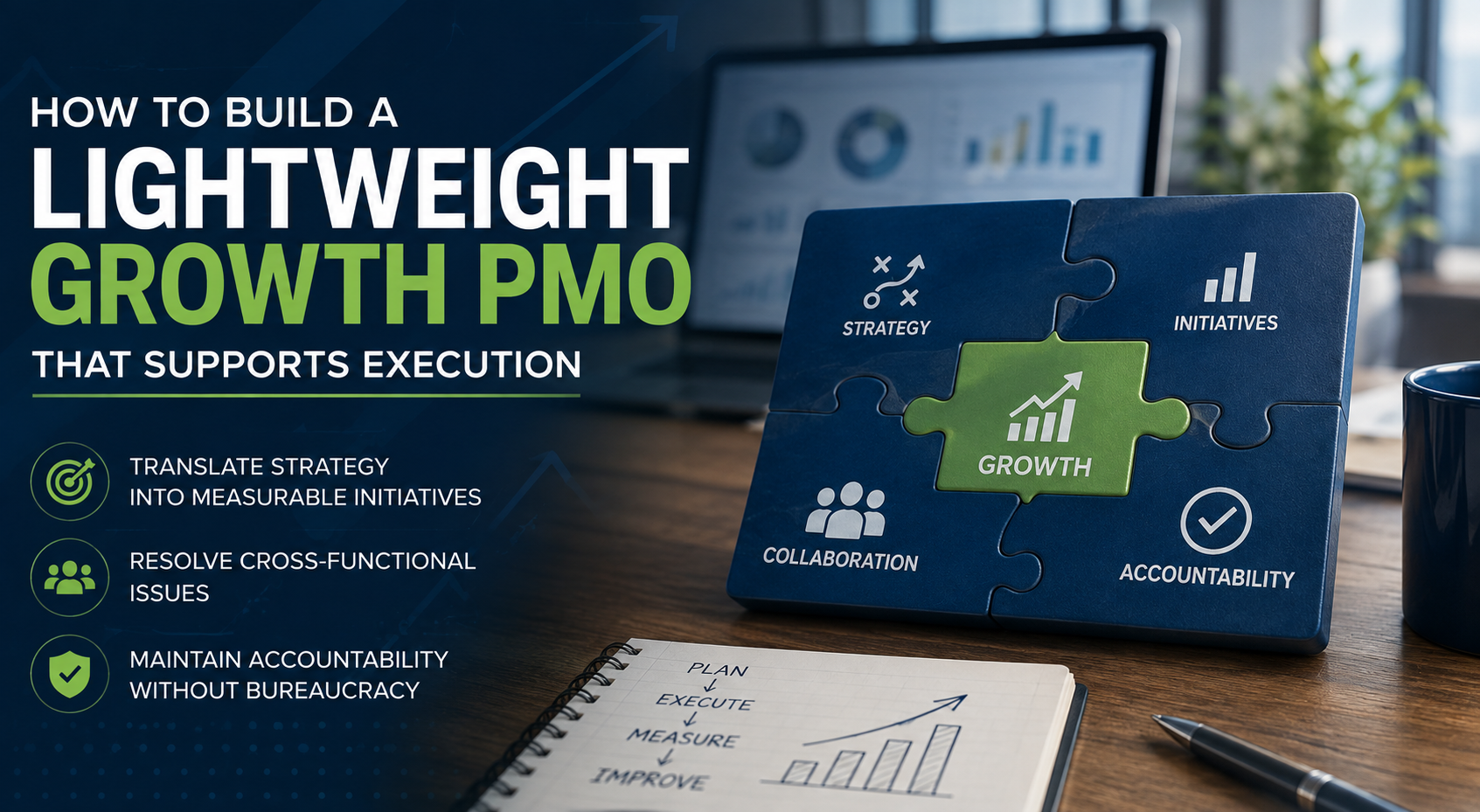
Growth strategies rarely fail because leaders cannot create a list of initiatives.
The harder problem begins after the strategy is approved.
Several functions may need to act at the same time. One initiative depends on another. Resources are shared. New information changes assumptions. Decisions cross organizational boundaries. A problem that appears operational in one department may require a commercial, financial, or leadership decision somewhere else.
As priorities increase, executive teams can spend more time coordinating work, resolving conflicts, and asking for status updates.
A growth PMO can help solve this problem, but only if it is designed for execution rather than administration.
The objective is not to create another layer of reporting between executives and the people doing the work. It is to create a lightweight operating mechanism that connects strategy to initiatives, establishes accountability, exposes cross-functional dependencies, and brings the right decisions to leadership at the right time.
Project Management Institute's current perspective on PMOs similarly emphasizes value delivery rather than treating the PMO primarily as an administrative project-control function.
For mid-market companies, the challenge is therefore not simply whether to create a PMO. The more useful question is:
What is the minimum amount of governance required to keep our most important growth priorities moving?
What Is a Growth PMO?
A traditional Project Management Office can do many useful things, including setting project standards, coordinating schedules, documenting progress, and supporting project managers.
A growth PMO, as we use the term here, has a narrower strategic purpose.
It exists to help an organization execute the relatively small number of initiatives that matter most to its growth strategy.
Those initiatives might include:
- Entering a new market
- Launching a new offering
- Building a new commercial capability
- Integrating an acquisition
- Expanding capacity
- Implementing a critical technology platform
- Improving an operating model
- Building a strategic partnership
- Changing the customer experience
- Delivering a major productivity initiative
The growth PMO does not need to control every project in the company.
Instead, it should maintain visibility into the initiatives where execution failure would materially affect strategic objectives.
This distinction matters.
If every activity becomes part of the PMO, the organization can spend more and more time feeding the governance system. If too little structure exists, cross-functional initiatives can drift until leadership discovers problems after important time or resources have already been lost.
The goal is the middle ground: enough structure to improve execution, but not so much that it slows it down.
Why Growth Creates an Execution Problem
Smaller businesses can often coordinate through direct communication.
A sales leader walks into the CEO's office. Operations speaks directly with finance. Problems can be resolved quickly because there are relatively few layers, priorities, and dependencies.
Growth changes that.
The company may add customers, employees, systems, products, locations, management layers, acquisitions, and strategic initiatives. Work increasingly crosses functions, each with its own objectives and operating rhythms.
An initiative that sounds simple at the strategy level can become much more complicated during execution.
Consider a company deciding to enter a new customer segment.
That choice could require coordinated decisions across:
- Product
- Sales
- Marketing
- Operations
- Finance
- Technology
- Talent
- Legal or compliance
- Customer support
Each function might execute its own responsibilities effectively while the overall initiative still falls behind.
The problem is not necessarily individual performance.
It often comes down to coordination at the intersections.
These intersections can also create what AP Consulting describes as decision friction, where unclear authority, excessive approvals, unresolved cross-functional trade-offs, or weak decision closure slow execution even when capable people are involved.
A growth PMO can provide an operating mechanism for identifying these issues before they become persistent leadership bottlenecks.
A Growth PMO Should Connect Strategy to Execution
One of the easiest ways a company loses strategic focus is by creating an initiative list without maintaining the logic behind it.
The organization starts with a strategic objective.
Then projects are launched.
Months later, executives receive updates on milestones, budgets, tasks, and completion percentages, but the connection between the work and the original strategic objective has become less clear.
A lightweight growth PMO should preserve that connection.
A useful chain looks like this:
Strategic choice → Growth objective → Initiative → Accountable owner → Milestones → Business outcome → Learning
For example:
Strategic choice: Expand within an attractive customer segment
Growth objective: Increase penetration among a defined group of customers
Initiative: Build a dedicated commercial approach for that segment
Accountable owner: Commercial leader
Milestones: Customer research completed, offer defined, sales process developed, pilot launched
Business outcome: Agreed measures of customer adoption and commercial performance
Learning: Determine whether evidence supports scaling, adapting, or stopping the initiative
The PMO's job is not to decide what every function should do.
Its job is to prevent the execution system from losing the strategic logic connecting the work.
This connects directly to AP Consulting's Choice Stack framework, which links enterprise aspirations with where-to-play, how-to-win, capability, resource, and operating choices.
The growth PMO effectively takes those choices one step further by maintaining visibility into whether the organization is actually executing them.
That also creates an important discipline:
An initiative should not remain strategically important simply because people are already working on it.
If assumptions change, the organization should be able to reconsider the initiative.
The Five Jobs of a Lightweight Growth PMO
A growth PMO does not need dozens of responsibilities.
For many organizations, five are enough.
1. Translate Strategic Priorities Into Initiatives
Strategy needs to become executable.
Broad statements such as "grow in healthcare," "digitize operations," or "improve customer experience" provide direction, but they do not establish the work required to produce an outcome.
The growth PMO can help leadership translate strategic priorities into a manageable portfolio of initiatives.
For every major initiative, leadership should be able to answer:
- Which strategic priority does this support?
- What business problem or opportunity are we addressing?
- What result are we trying to create?
- Who owns that result?
- What capabilities or resources are required?
- What assumptions must prove true?
- How will we know whether the initiative is working?
This process can also reveal a different problem: too many priorities.
If executives describe twenty initiatives as equally critical, the PMO should not simply build a twenty-row dashboard.
It should help expose the resource and sequencing choices embedded in that portfolio.
2. Establish Clear Ownership and Outcomes
Every strategic initiative needs ownership, but ownership is often misunderstood.
Someone can own the project plan without owning the business outcome.
Consider a CRM implementation.
The technology team may own the technical implementation.
A project manager may own the schedule.
A vendor may own configuration.
None of those parties necessarily owns the commercial result the investment was intended to create.
If the strategic reason for the project is improving commercial performance, a business leader should remain accountable for whether the new capability actually changes how the commercial organization operates.
This creates two useful forms of ownership:
Execution ownership: Who coordinates delivery?
Outcome ownership: Who is accountable for the business result?
Sometimes the same person can perform both roles. Often they should not.
The growth PMO should make the distinction visible.
3. Make Dependencies Visible
Many important initiatives become difficult at the boundaries between functions.
Marketing needs product information.
Sales needs pricing.
Operations needs demand forecasts.
Technology needs process decisions.
Finance needs assumptions.
Integration teams need decisions from leaders who are simultaneously running the underlying business.
When these dependencies remain invisible, each team can report that its work is progressing while the initiative as a whole stalls.
A lightweight growth PMO should maintain a short dependency log focused on material constraints.
The important word is material.
The growth PMO does not need to track every handoff. It should focus attention on dependencies capable of changing the outcome, timing, economics, or risk of the initiative.
4. Escalate Decisions, Not Status Updates
A common PMO failure mode is turning senior leadership meetings into project narration.
One owner explains that an initiative is green.
Another explains why something moved from green to yellow.
Another reviews tasks completed during the previous month.
Executives receive information but make few decisions.
A growth PMO should reverse that logic.
Routine status information can be distributed before the meeting.
Leadership time should concentrate on questions such as:
- Which initiative requires a decision?
- What trade-off has to be made?
- Which assumption changed?
- Where are two functions unable to resolve a conflict?
- Where is resource capacity limiting execution?
- Which initiative should accelerate?
- Which initiative needs to change?
- Which initiative should stop?
The distinction is simple:
A status problem belongs in the operating process. A decision problem belongs with the appropriate decision-maker.
This is one reason a lightweight PMO can create leadership leverage. Senior managers spend less time collecting information and more time resolving the relatively small number of issues that require their authority or judgment.
5. Maintain an Execution Rhythm
Execution should not depend on whether someone remembers to ask about an initiative.
A growth PMO creates a repeatable rhythm.
The exact cadence depends on the business, but a simple model could include:
Weekly initiative management
Initiative owners manage milestones, immediate constraints, and team-level decisions.
Biweekly or monthly cross-functional review
Owners review material dependencies, changes in assumptions, resource conflicts, and risks.
Monthly executive growth review
Leadership focuses on strategic outcomes, major decisions, portfolio trade-offs, and initiatives requiring intervention.
Quarterly portfolio review
Leadership reassesses whether the overall initiative portfolio still reflects the strategy and current business environment.
This rhythm reduces the need for constant ad hoc escalation while still creating predictable opportunities to address problems.
It follows the same principle discussed in AP Consulting's From Firefighting to Growth System: operating rhythms, clearer escalation paths, and repeatable management systems can reduce unnecessary senior intervention as organizations become more complex.
What Should Be on a Growth PMO Scorecard?
The scorecard is where a growth PMO can either become useful or become bureaucratic.
If it measures everything, leaders struggle to see what matters.
If it only measures project completion, the organization can confuse activity with progress.
A useful scorecard should connect execution to business outcomes.
This distinction between delivery and benefits matters.
A project can finish on time while failing to produce the result that justified the investment.
PMI's Benefits Realization Management Practice Guide describes benefits realization as the connection running from organizational strategy through project deliverables to the benefits those deliverables are intended to produce.
For that reason, the scorecard should eventually move beyond:
Did we complete the project?
to:
Did completing the project change the business in the way we expected?
How to Keep the Growth PMO Lightweight
The best test of a lightweight PMO is not the number of templates it produces.
It is whether the organization can make better execution decisions with less coordination burden.
Several principles can help.
Use Minimum Viable Governance
Begin with the smallest operating system capable of creating visibility and accountability.
For many mid-market companies, that might mean:
- One initiative charter
- One portfolio view
- One dependency and decision log
- One outcome scorecard
- One regular executive review
Add processes only when recurring execution problems demonstrate that additional structure is necessary.
This approach is consistent with the broader goal of building effective governance for growth: governance should support better decisions and accountability without becoming an unnecessary constraint on the organization's ability to act.
Manage by Exception
Executives do not need equal detail on every initiative.
A strategically important initiative that is progressing as expected may require little discussion.
An initiative with a newly invalidated assumption may deserve most of the meeting.
Governance should direct attention toward deviation, uncertainty, trade-offs, and decisions.
Limit the Number of Metrics
If an initiative requires twenty-five metrics to explain whether it is succeeding, leadership may not have agreed on the result it is trying to create.
Most initiatives should have a small number of meaningful outcome measures supported by operational indicators where necessary.
Keep Reporting Close to the Work
The PMO should not create a parallel information system that requires teams to manually reproduce data already available elsewhere.
Where practical, existing operating and financial data should feed the growth review.
Give Governance an Expiration Test
Not every strategic initiative requires permanent governance.
As an initiative becomes part of normal operations, ask whether PMO oversight still adds value.
The organization should be willing to retire meetings, reports, metrics, and governance mechanisms that no longer solve an important problem.
Lightweight Growth PMO vs. Bureaucracy-Heavy PMO
The difference is not simply team size.
It is how the PMO thinks about its role.
The objective is not less discipline.
It is more selective discipline.
PMI's June 2026 discussion of the changing role of the PMO makes a similar distinction, arguing that growing complexity requires PMO capability that connects strategy to execution and improves enterprise decision-making rather than merely adding project oversight.
What the Growth PMO Should Not Own
A strong PMO can become a weak organization's workaround.
That should be avoided.
The growth PMO should generally not become responsible for:
Functional Performance
Sales leadership should still own sales.
Operations should still own operations.
Finance should still own finance.
The PMO helps coordinate strategic initiatives across those functions. It should not replace functional accountability.
Every Business Decision
If routine decisions consistently require PMO or executive approval, decision rights may be set at the wrong level.
The PMO should help identify this problem, not institutionalize it.
Strategy Itself
The growth PMO can provide information about execution, changing assumptions, and business outcomes.
Leadership still needs to make strategic choices.
Permanent Rescue Work
If the PMO repeatedly solves the same cross-functional problem, there may be an underlying issue in process design, organizational structure, decision rights, capabilities, or incentives.
The long-term answer may be to fix that system rather than continue escalating the problem through the PMO.
When Is a Growth PMO Most Useful?
Not every organization needs a dedicated growth PMO.
The capability becomes particularly useful when the organization's strategy requires several important initiatives that cannot be executed within a single function.
Common situations include:
- Enterprise transformation
- Post-merger integration
- Expansion into new markets
- Launching new business models
- Major technology transformations
- Building new organizational capabilities
- Large productivity programs
- Capacity expansion
- Portfolio-company transformation
- Simultaneous growth initiatives competing for limited resources
M&A is a particularly clear example because integration creates dependencies across leadership, people, operations, customers, technology, finance, and other functions. AP Consulting's article on Integration Velocity examines how decision rights, cross-functional coordination, issue escalation, and operating rhythms influence the speed at which the transaction thesis becomes operating reality.
A growth PMO can also be temporary.
A company might establish one during an integration or major transformation and later transfer the necessary governance mechanisms into normal operating processes.
The design should follow the execution challenge rather than an assumption that every organization needs a permanent PMO structure.
A Simple 90-Day Approach to Building a Growth PMO
A mid-market organization does not need to spend months designing the perfect PMO before using it.
A practical approach can begin with the existing strategy and current work.
Days 1-30: Establish the Portfolio
Start by identifying the relatively small number of initiatives that are genuinely strategic.
For each initiative, document:
- Strategic objective
- Business outcome
- Accountable owner
- Initiative lead
- Major milestones
- Critical assumptions
- Material dependencies
- Key outcome measures
Then ask a difficult question:
If everything on this list is a priority, what is actually a priority?
This first month should reduce ambiguity rather than create documentation.
Days 31-60: Establish the Execution Rhythm
Begin regular reviews.
Do not attempt to perfect every dashboard first.
Use the meetings to learn what information leaders actually need to make decisions.
Track:
- Meaningful changes
- Decisions required
- Material dependencies
- Risks to outcomes
- Resource conflicts
- Changed assumptions
If a field on the dashboard never changes a discussion or decision, reconsider whether it needs to exist.
Days 61-90: Simplify and Strengthen
After several operating cycles, patterns should become visible.
Ask:
- Which issues repeatedly escalate?
- Which decisions take too long?
- Which initiatives have unclear ownership?
- Where are dependencies causing delays?
- Which metrics actually help leadership?
- Which reports are rarely used?
- Which meetings can be shortened or eliminated?
- Which initiatives no longer support the strategy?
- Where does accountability need to move back into the business?
The objective of the first 90 days is not to finish designing the PMO.
It is to create an execution system, use it, learn from it, and simplify it.
Build an Execution System, Not Another Layer
A growth PMO should make strategy easier to execute.
It should help executives see whether strategic priorities have become measurable initiatives, whether those initiatives have accountable owners, where dependencies are slowing progress, and which decisions require leadership intervention.
Done well, it does not add control for the sake of control.
It provides enough structure to keep the organization's most important priorities connected while allowing capable leaders and teams to execute within clear boundaries.
That is the real test.
If the PMO requires more executive coordination than it removes, it has probably become part of the problem.
If it gives leaders greater visibility while pushing appropriate decisions closer to the people doing the work, it can become a valuable source of organizational leverage.
The ultimate goal is therefore not to build a bigger PMO.
It is to build a company that can translate strategy into coordinated action, learn from execution, and keep moving without requiring senior leaders to personally manage every intersection.
If your organization has clear growth priorities but struggles to translate them into coordinated execution, AP Consulting can help clarify initiative ownership, decision rights, operating rhythms, and the governance needed to keep strategic priorities moving.