
How to Evaluate a Growth Opportunity Before Committing Resources
Growth opportunities rarely arrive with complete evidence.
A customer asks for a new service. A competitor enters a promising market. A new technology creates possibilities that did not exist two years ago. An executive identifies an attractive acquisition target. A business unit proposes taking an existing capability into a new industry.
Each opportunity may deserve attention. Few organizations, however, have enough capital, talent, operating capacity, or leadership time to pursue every attractive idea.
The challenge is not simply finding opportunities. It is determining which opportunities deserve resources, which require further testing, and which should be postponed or rejected.
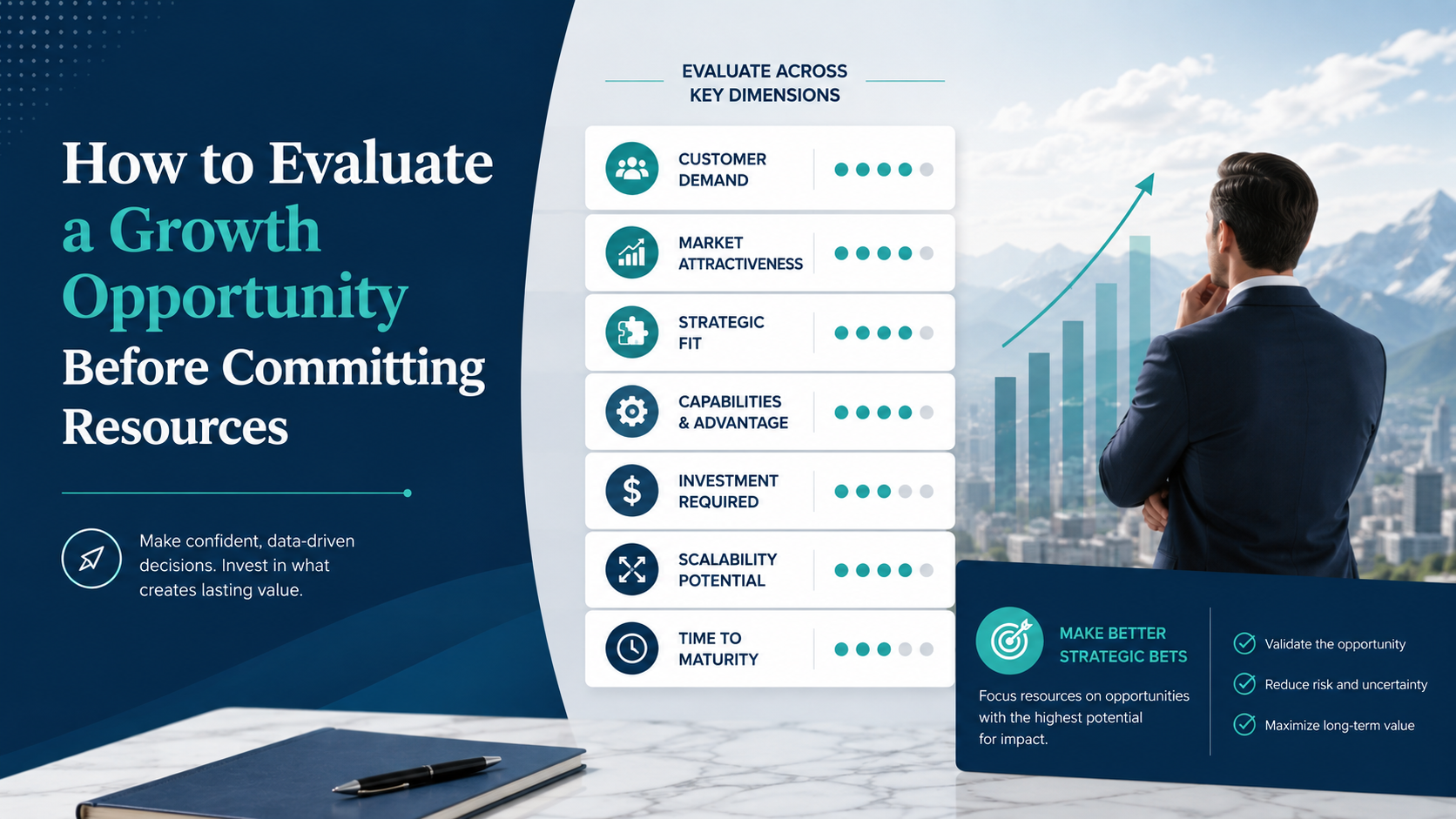
A structured growth opportunity assessment helps leadership teams make that distinction. It evaluates the strength of customer demand, the attractiveness of the market, the organization’s strategic fit and right to win, the capabilities required, the economic logic, and the time needed for the opportunity to mature.
The purpose is not to eliminate uncertainty. That is rarely possible. The purpose is to understand the uncertainty well enough to make an informed next commitment.
What Is a Growth Opportunity Assessment?
A growth opportunity assessment is a structured evaluation of an initiative’s external attractiveness and the organization’s internal ability to execute it.
It is broader than an idea screen, which may only determine whether an idea deserves initial attention. It is also different from a financial forecast, which estimates future performance based on assumptions that may not yet have been validated.
A useful assessment examines four questions:
- Is there a meaningful opportunity?
- Is this opportunity appropriate for our strategy?
- Do we have a credible way to win?
- What must we learn or build before committing further resources?
The process should separate facts from assumptions. It should identify what the organization knows, how it knows it, what remains uncertain, and what evidence would support the next funding decision.
This distinction matters because growth initiatives are not equally uncertain. An effort to improve sales execution in an established market should not be evaluated in the same way as a new product, geographic expansion, or disruptive business model.
Classify the Opportunity Before Evaluating It
Before applying the assessment, leadership should determine what type of growth opportunity it is considering.
AP Consulting’s growth framework organizes opportunities into core growth, market adjacencies, product adjacencies, and disruptive potential. Each path has different requirements, risks, and expected timelines.
Leaders can explore this distinction in more detail in How to Balance Core Growth, Adjacencies, and Disruptive Bets.
Core growth focuses on capturing more value from markets, products, and customers the company already understands.
Market adjacency takes an existing product or capability to a new customer segment, industry, or geography.
Product adjacency uses existing knowledge, technology, or customer access to introduce a related offering.
Disruptive potential explores a materially different business model or solution, often for customers who are not well served by established alternatives.
Distance from the core generally increases the number of assumptions that must be tested. It may also increase capability requirements, time to maturity, and the likelihood that a different operating model will be needed.
Before moving away from the core, leadership should also determine whether the existing business has enough market headroom to meet its objectives. How to Know When Your Core Business Can No Longer Support Your Growth Goals provides a practical framework for making that distinction.
A Seven-Part Growth Opportunity Assessment Framework
A strong assessment brings multiple dimensions together. No single test, including market size, customer interest, projected revenue, or strategic fit, is enough on its own.
The following seven-part framework can help leadership teams examine an opportunity before making a major commitment.
1. Is There Evidence of Meaningful Customer Demand?
Customer demand should be the starting point.
Teams often begin with the proposed solution: a product they could build, a market they could enter, or a technology they could commercialize. The more important starting question is whether a specific customer has a meaningful problem that requires action.
Ask:
- Who is the customer?
- What progress is the customer trying to make?
- How important is the problem?
- What does the customer do today?
- What is unsatisfactory about the current solution?
- Who makes the purchasing decision?
- Who controls the budget?
- What would cause the customer to change?
- What evidence suggests a willingness to buy, adopt, or switch?
Jobs to Be Done research can help teams look beyond product preferences and understand the outcomes customers are trying to achieve.
For a deeper explanation of how customer research can reveal stronger opportunities, read How Jobs to Be Done Helps Leaders Find Better Growth Opportunities.
Leaders should also distinguish between different levels of evidence.
A positive interview is useful, but it is not the same as a purchasing commitment. Customers may like an idea without considering the problem important enough to change behavior, secure approval, accept implementation risk, or allocate budget.
The assessment should therefore ask not only, “Do customers like this?” but also, “What are customers prepared to do differently?”
2. Is the Market Attractive Enough?
Customer need and market attractiveness are related but separate questions.
A real customer problem may exist inside a market that is too small, difficult to reach, concentrated, heavily regulated, or structurally unprofitable. Conversely, a large market may look attractive at a high level while offering little realistic room for a new entrant.
The assessment should consider:
- The size of the realistically reachable market
- Market growth and the forces driving it
- Customer concentration
- Competitive intensity
- Margin structure
- Substitutes and alternative solutions
- Switching costs
- Regulatory constraints
- Technology changes
- Route-to-market barriers
- The likely competitive response
Avoid using the total addressable market as the primary justification for investment. A broad industry estimate does not show how much of that market the business can reach, serve, or win.
Leadership should determine the serviceable and winnable opportunity based on its target customers, geographic reach, delivery model, sales capacity, pricing, and competitive position.
The timing of the opportunity also matters. A market may be attractive in the long term but unready today. Customers may lack budget, infrastructure, regulatory clarity, technical readiness, or internal support. In that situation, monitoring or testing may be more appropriate than a full launch.
In highly uncertain conditions, leaders may also need to evaluate several possible market outcomes instead of relying on a single forecast. Developing Growth Strategies in Uncertain Times explains how leadership teams can connect different growth bets to appropriate evidence, risk levels, and reassessment signals.
3. Does the Opportunity Fit the Strategy?
A strong market does not automatically create a strong strategic opportunity for every company.
Strategic fit asks whether the opportunity supports the organization’s choices about where to play, how to win, what capabilities to develop, and what value to create.
Leadership should ask:
- Does this opportunity reinforce a market we have chosen to serve?
- Does it strengthen our value proposition?
- Does it use or extend an important capability?
- Does it support our long-term position?
- Does it complement the existing portfolio?
- Would it distract resources from a stronger priority?
- Could it weaken service, quality, or execution in the core?
- Can we clearly explain why this opportunity belongs in our strategy?
Strategic fit does not require the opportunity to look identical to the current business. A well-chosen adjacency may deliberately take the company into a new market or product category.
The test is whether the move is coherent. There should be a clear connection between the opportunity, the company’s strategic direction, and the capabilities through which it expects to create value.
The Choice Stack offers a practical way to connect market priorities, customer choices, competitive advantage, capabilities, resource allocation, and execution. It can help leadership determine whether a proposed opportunity strengthens the company’s strategy or introduces another disconnected priority.
4. Does the Company Have a Right to Win?
The ability to enter a market is not the same as the ability to win in it.
Many companies can develop a product, hire salespeople, or launch a new service. Fewer can provide customers with a compelling reason to choose them once established competitors respond.
A right to win may come from:
- Trusted customer relationships
- Specialized knowledge
- Proprietary technology
- Intellectual property
- Data
- Brand credibility
- Cost position
- Distribution access
- Operational expertise
- Installed equipment or infrastructure
- Strategic partnerships
- The ability to integrate the offer with an existing solution
Ask:
- What can we offer that customers cannot easily obtain elsewhere?
- Which advantages transfer to this opportunity?
- Which advantages are assumed rather than demonstrated?
- How durable are those advantages?
- How easily can competitors copy or neutralize them?
- Why would customers choose us after competitors respond?
Leaders should be careful with claims of “synergy.” Sharing customers, technology, or overhead may create efficiencies, but those similarities do not automatically produce customer value or competitive advantage.
A credible right to win should explain both why the company is suited to the opportunity and why customers are likely to care.
5. Can the Organization Build and Scale the Required Capabilities?
An attractive opportunity can still fail when the organization lacks the ability or capacity to execute it.
The capability assessment should include:
- Product or service development
- Technical expertise
- Sales
- Marketing
- Pricing
- Customer onboarding
- Delivery
- Customer support
- Technology
- Data
- Compliance
- Supply chain
- Partnerships
- Leadership capacity
- Performance management
Classify each important capability honestly.
Leaders must also distinguish capability from capacity.
A company may know how to deliver the solution but lack enough people, equipment, working capital, systems, or management attention to support meaningful growth.
Do Not Mistake a High-Touch Pilot for a Scalable Model
Early pilots often receive unusual support.
Senior leaders intervene. The strongest employees are assigned. Exceptions are made to normal processes. Costs are absorbed elsewhere. Customer problems are resolved manually.
These actions may be appropriate for learning, but they can make the pilot appear more scalable than it is.
Before committing to expansion, determine whether the organization can repeat customer acquisition and delivery without extraordinary intervention. Assess whether quality, economics, customer experience, and operating control can be maintained as volume increases.
Leadership should also consider whether the opportunity will increase dependence on a few senior people. From Firefighting to Growth System: How Small Teams Create More Leverage explains how processes, decision rights, technology, and learning systems can help an organization scale without requiring continuous executive intervention.
6. Are the Investment Requirements and Economics Credible?
An opportunity assessment should make the full resource requirement visible.
The investment is rarely limited to the cost of developing a product or opening a location. Growth may require new talent, technology, marketing, sales capacity, inventory, equipment, compliance support, working capital, partnerships, customer onboarding, and management infrastructure.
Evaluate:
- Upfront capital
- Ongoing operating expense
- Development cost
- Capability-building cost
- Customer acquisition cost
- Delivery and support cost
- Capacity investments
- Working-capital requirements
- Expected gross margin
- Time to break even
- Downside exposure
- Opportunity cost
- Likely need for additional funding
Separate the investment into three categories.
Investment to Learn
What must be spent to validate customer demand, technical feasibility, pricing, delivery, or route to market?
Investment to Launch
What resources are required to introduce the offer to a defined customer group?
Investment to Scale
What must be added once the model has demonstrated traction?
This separation prevents leadership from treating the total cost of the opportunity as one irreversible decision.
Financial forecasts should use ranges and scenarios rather than false precision. A base case, downside case, and upside case can reveal which assumptions have the greatest effect on the outcome.
Leaders should pay particular attention to assumptions involving customer adoption, sales-cycle length, pricing, delivery cost, retention, capacity, and working capital.
Resource allocation should also reflect the type of growth being pursued. Core growth, adjacencies, and disruptive opportunities should not automatically compete against one another using identical funding criteria. The article on balancing core growth, adjacencies, and disruptive bets provides additional guidance for structuring these portfolio choices.
7. What Is the Realistic Time to Maturity?
Growth opportunities do not mature at the same speed.
A core execution initiative may produce evidence within a quarter. A market adjacency may require a longer period to build credibility and distribution. A new product may require technical development and customer trials. A disruptive business model may need several learning cycles before its potential becomes visible.
Ask:
- How long will customer validation take?
- How long is the expected buying cycle?
- What technical or regulatory dependencies exist?
- When could revenue become meaningful?
- When could the initiative contribute profit or cash?
- What evidence should appear within 90 days?
- What should be known within six months?
- What would justify further investment after one year?
- How long can the organization support the initiative before it must mature?
Go-to-market planning should be part of the opportunity assessment rather than a later implementation activity. Leadership needs to understand how customers buy, what proof they require, and how long commercial conversion is likely to take.
A long time to maturity does not necessarily make an opportunity unattractive. It does, however, affect how it should be funded, governed, measured, and compared with other opportunities.
Convert the Assessment Into a Resource Decision
The final decision does not need to be limited to “fund” or “reject.”
A good assessment should help leadership select the appropriate next action.
Fund
Fund the opportunity when customer evidence, strategic fit, competitive advantage, capabilities, economics, and timing are sufficiently strong.
Funding can still be released in stages, particularly when scaling introduces new risks.
Test
Test the opportunity when it appears attractive but important assumptions remain unresolved.
The test should target a specific uncertainty. It might validate willingness to pay, technical feasibility, customer acquisition, delivery cost, partner performance, or repeat usage.
Build Capabilities First
The opportunity may be credible while the organization remains unprepared to deliver it.
In that case, leadership may need to strengthen talent, systems, technology, operations, distribution, or leadership capacity before launching.
Partner, License, or Acquire
Internal development is not always the most effective route.
A partnership, licensing arrangement, joint venture, or acquisition may provide faster access to technology, talent, customers, infrastructure, or distribution. The decision should consider control, integration, incentives, dependency, and cost.
When acquisition is the preferred route, leaders should also assess how quickly the acquired capabilities can be integrated without damaging the value thesis. Integration Velocity: The Overlooked Metric That Makes or Breaks M&A Value examines how the appropriate integration model changes across core, adjacency, and capability acquisitions.
Monitor
Some opportunities are directionally attractive but premature.
Customer readiness, economics, regulation, or technology may need to develop further. Monitoring should include defined indicators and a scheduled reassessment rather than leaving the idea in an indefinite backlog.
Stop
Stopping is appropriate when the opportunity lacks meaningful demand, strategic coherence, defensible advantage, credible economics, or a realistic execution path.
A disciplined stop decision protects resources for stronger opportunities. It may also preserve useful learning that can be applied elsewhere.
Common Growth Opportunity Assessment Mistakes
Leadership teams should watch for several recurring errors.
Starting With Market Size Instead of the Customer Problem
A large market does not prove that customers have an unmet need or that the company can reach them.
Building Forecasts From Unverified Assumptions
A detailed spreadsheet can create an impression of certainty while relying on untested adoption, pricing, margin, or timing assumptions.
Treating Adjacency as Proof of Capability Fit
A market or product may appear close to the core while requiring a substantially different sales process, operating model, or customer relationship.
Underestimating Go-to-Market Difficulty
Customer interest does not automatically convert into revenue. Buying processes, credibility requirements, distribution, implementation risk, and sales cycles can materially change the opportunity.
Treating Pilot Success as Proof of Scalability
A pilot supported by senior leaders and exceptional resources may not represent the cost or complexity of normal delivery.
Funding Long-Term Opportunities With Short-Term Expectations
A disruptive or capability-intensive initiative may require learning milestones before conventional revenue and profit measures become useful.
An opportunity can be strategically attractive and still be unready for full funding.
Fund the Next Stage, Not the Entire Story
A growth opportunity assessment cannot remove every uncertainty. It can make uncertainty visible, identify the assumptions that matter most, and determine what the organization should learn next.
The strongest leadership teams do not demand complete certainty before acting. They also do not commit major resources based only on enthusiasm, market headlines, or ambitious forecasts.
They classify the opportunity, evaluate it across multiple dimensions, and match the size of the commitment to the strength of the evidence.
For some opportunities, the right decision will be to fund and scale. For others, it will be to test customer demand, build a capability, find a partner, monitor the market, or stop.
The value of a growth opportunity assessment is not that it produces a perfect prediction. It helps leaders direct capital, talent, and attention toward the next action most likely to improve the quality of the decision.
AP Consulting helps executive teams evaluate growth opportunities, test critical assumptions, and align resources behind initiatives with strong strategic and commercial logic. Contact AP Consulting to discuss your growth priorities and decision process.